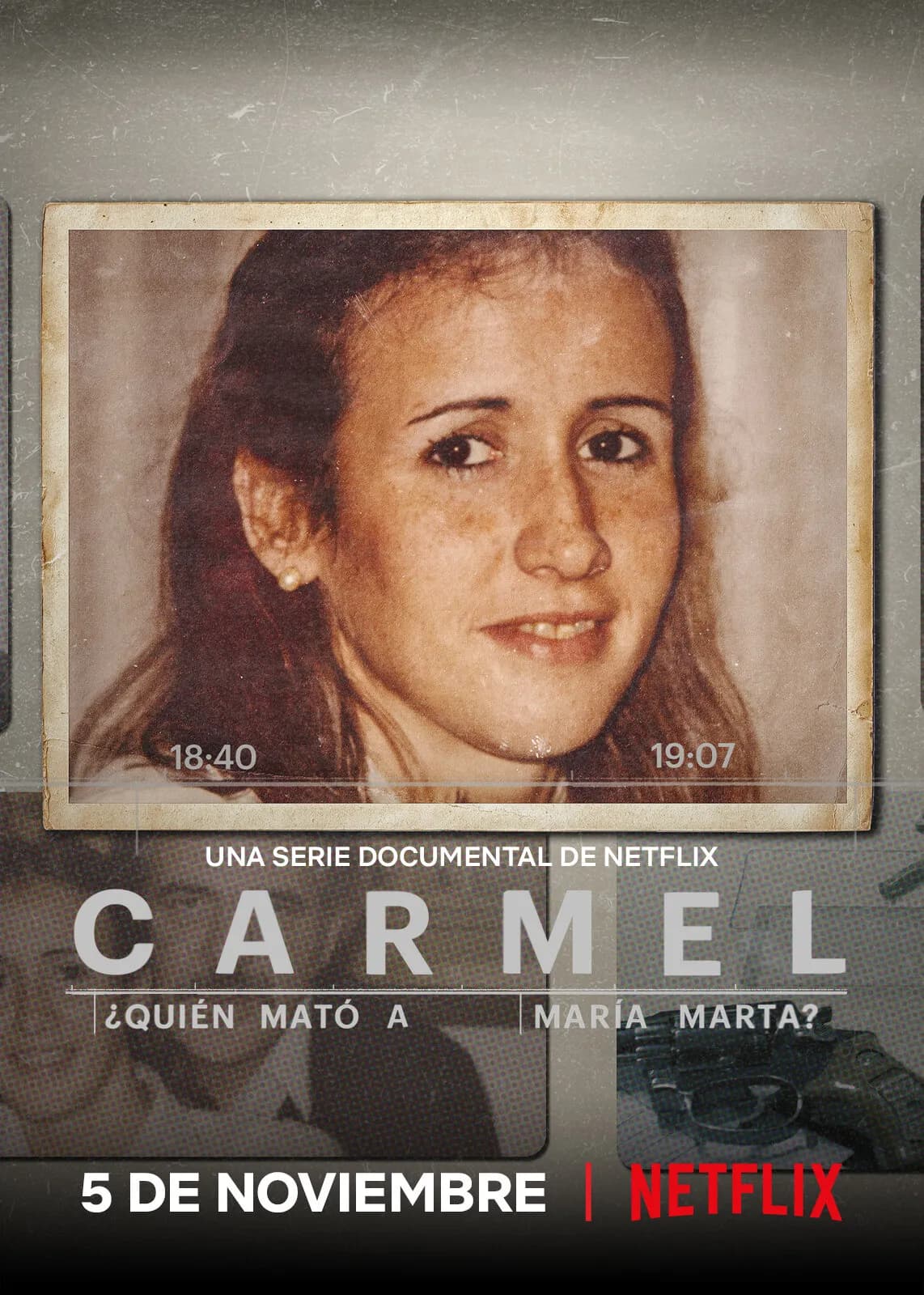
Carmel: ¿Quién mató a María Marta?
Netflix, 2020 — the unsolved murder of María Marta García Belsunce in a Buenos Aires gated community
Quick facts
What Is the Series About?
*Carmel: ¿Quién mató a María Marta?* is a four-episode Netflix documentary miniseries directed by Alejandro Hartmann and released in November 2020. The series examines one of the most polarizing and unresolved criminal cases in Argentine history: the murder of María Marta García Belsunce de Carrascosa, a 50-year-old sociologist who was found dead on 27 October 2002 in her home inside the exclusive Carmel gated community in Pilar, Buenos Aires Province, Argentina. Over its four episodes, the series reconstructs the chain of events, the mishandled initial investigation, the years of trials, and the competing theories about who pulled the trigger — a question that, despite two decades of legal proceedings, remains unanswered.
The Case
On the evening of 27 October 2002, María Marta García Belsunce was found dead at her residence in Carmel, a private country club community in Pilar, roughly 50 kilometres north of Buenos Aires. Born on 24 April 1952, she was 50 years old at the time of her death. In the immediate aftermath, the scene was handled with alarming informality: authorities initially accepted the explanation that she had suffered a domestic accident, possibly a fall, and the body was not treated as a homicide scene. No thorough forensic examination was conducted at the outset.
It was only after a subsequent autopsy — performed considerably later — that the truth emerged: María Marta had been shot multiple times in the head. The misclassification of her death was itself scandalous and became a central thread in all subsequent legal and media coverage. How could multiple gunshot wounds go undetected, and by whom?
Suspicion quickly fell on her widower, Carlos Carrascosa, a prominent figure in the Buenos Aires upper-class social milieu that populated Carmel. After years of investigation and legal battles, Carrascosa was convicted of homicide aggravated by the marital bond and sentenced to life imprisonment. He spent approximately seven years behind bars before the Supreme Court of Buenos Aires ordered his release in 2016, finding him innocent. His case illustrated how the Argentine justice system struggled throughout this investigation: the initial mishandling of evidence, the reliance on circumstantial inference, and the enormous social pressure generated by the victim's and accused's privileged backgrounds all distorted the proceedings.
As Carrascosa's conviction unravelled, attention shifted to Nicolás Pachelo, a former neighbor of the García Belsunce family at Carmel who had a documented history of theft and robberies in gated communities and was already incarcerated for other offences when the case resurfaced. CNN Español reported extensively on the Pachelo proceedings in 2022, which became the most anticipated legal chapter of the saga since the original trial. However, Pachelo was ultimately acquitted. According to BBC Mundo, the acquittal effectively closed the legal avenue: prescription and procedural rules meant the case could not be meaningfully pursued against any other individual.
The documentary also surveys the several competing theories that circulated over the years, including a marital dispute, a contract killing carried out by a hired sicario, and a robbery-related homicide that escalated fatally. La Nación catalogued some of the more speculative hypotheses that emerged from media coverage of the case, underscoring how the vacuum left by the absence of a proven perpetrator fuelled intense public speculation for years.
Production
The series was directed by Alejandro Hartmann and produced for Netflix, premiering in November 2020. Hartmann structured the four episodes to trace the case chronologically while weaving in testimonies, archival footage, and expert commentary that illuminate how the investigation evolved — and repeatedly stumbled. The format follows the established conventions of prestige true-crime documentary: intimate talking-head interviews are counterbalanced with reconstructed sequences and media archive material that captures how Argentine television and the press covered the case in real time.
The choice to revisit the case at this particular moment was editorially significant. By 2020, Carrascosa had already been released and cleared, and the Pachelo proceedings were gathering momentum. The series therefore arrives at a juncture when the identity of the killer remains not only publicly contested but legally open, giving it a quality of genuine unresolved suspense rather than retrospective verdict. The official Netflix trailer is available on YouTube and reflects the series' tense, procedural tone.
The production benefits from the extraordinary amount of documented material the case generated over nearly two decades: court records, television interviews, forensic reports, and the voluminous press coverage that accompanied each twist in the legal saga. Hartmann uses this archive to show how narratives about the case were constructed, challenged, and dismantled — making the series as much about the mechanics of Argentine media and justice as about the crime itself.
Reception
Upon its Netflix release in November 2020, Carmel: ¿Quién mató a María Marta? was immediately one of the most discussed titles on the platform in Argentina and the broader Spanish-language market. El Confidencial described it as a standout true-crime hit that tapped into the same cultural appetite for cold-case reinvestigation that had fuelled international series such as Making a Murderer and The Staircase.
The controversy surrounding the series was almost inseparable from the controversy surrounding the case itself. Viewers and commentators debated not only the documentary's editorial choices but the underlying question it posed: after eighteen years of trials, convictions, acquittals, and reversals, who actually killed María Marta? The series made no claim to answer that question definitively — a decision that some praised as journalistic honesty and others criticised as dramatically unsatisfying.
The series holds an IMDb listing under title ID tt13244092, though a verified numeric user rating was not available in the sources consulted for this article.
The Case Today
As of the most recent reporting available, the murder of María Marta García Belsunce remains legally unresolved. Carlos Carrascosa, who spent roughly seven years in prison for a crime the Buenos Aires Supreme Court ultimately determined he did not commit, has been judicially cleared. Nicolás Pachelo, the former neighbor who became the central suspect in later proceedings, was acquitted in 2022. The combination of those acquittals and applicable legal prescription rules means, according to BBC Mundo's coverage, that no further prosecution is realistically possible.
The case endures as a defining moment in Argentine criminal justice — a case study in forensic mismanagement, class dynamics, media pressure, and the fallibility of the justice system. The Netflix documentary gave the story a new international audience and ensured that, whatever the courts may or may not decide, the question posed by the series title will continue to be debated: Who killed María Marta?