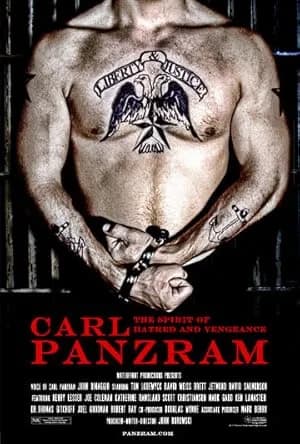
Carl Panzram: The Spirit of Hatred and Vengeance
Apple TV, 2011 — Documentary on American serial killer Carl Panzram's life, crimes, and 1930 execution
Quick facts
What Is the Film About?
*Carl Panzram: The Spirit of Hatred and Vengeance* is a 2011 standalone documentary feature directed by John Borowski that examines the life, crimes, confessions, and execution of Charles "Carl" Panzram — widely regarded as one of the most viciously unrepentant serial killers in American history. Running approximately 1 hour and 21 minutes, the film is built primarily around Panzram's own prison autobiography, a document of extraordinary brutality and self-awareness that he produced while incarcerated in a Washington, D.C. jail in 1928. The documentary is available on Apple TV, Netflix, and Prime Video, as well as through Local Now, reflecting its broad catalog reach within the true-crime streaming landscape.
The Case
Carl Panzram was born in 1891 and endured a childhood defined by poverty, institutional violence, and abuse — experiences he later described in unflinching detail in his written confessions. Rather than inspiring sympathy, Panzram transformed his suffering into a lifelong philosophy of hatred and revenge directed at humanity as a whole. By the time he was arrested in Washington, D.C. in 1928 — initially for the relatively mundane offense of stealing a radio and jewelry — he had accumulated a criminal record spanning decades and multiple continents.
Panzram ultimately confessed to murdering 21 boys and men, though investigators were able to corroborate only five of those killings through available evidence. His crimes extended well beyond murder: he was also a prolific burglar, arsonist, and rapist, making him one of the most comprehensively violent offenders in the documented history of American crime. His confession was not coerced — it was, by all accounts, volunteered with a kind of ferocious pride.
The pivotal human relationship at the center of the documentary is the unlikely bond between Panzram and Henry Lesser, a jail guard who befriended him during his 1928 detention. Lesser secretly provided Panzram with pencil and paper, encouraging him to document his life. The result was a raw, deeply disturbing autobiography that became both a primary historical source and the narrative backbone of Borowski's film. It is a document that criminologists, historians, and psychologists have studied for decades as a window into the mind of a man who felt — and expressed — zero remorse.
After his conviction, Panzram was sent to Leavenworth Prison in Kansas, where he murdered a prison laundry supervisor. He was subsequently sentenced to death. He was executed by hanging in 1930, and reportedly told his executioner to "hurry it up" — a final act of defiance consistent with every account of his personality. He was 38 years old.
Production
Director John Borowski is a filmmaker with a focused body of work in true-crime documentary, having previously explored other infamous American killers. For The Spirit of Hatred and Vengeance, Borowski centers the film on primary source material: Panzram's own words from his autobiography and confessions, supplemented by archival imagery, period documents, and expert commentary. The approach gives the documentary an unusually intimate and disturbing texture — viewers are confronted not with a narrator's interpretation of evil, but with Panzram's own voice describing it.
The film is listed on IMDb under title ID tt1756447 with genre labels of Documentary, Biography, and Crime. IMDb records a primary release year of 2011, with an additional 2013 United States release date entry that suggests a staggered or expanded domestic distribution. The production draws no punches in its subject matter: murder, rape, arson, and institutional abuse are all addressed directly, making the film suitable only for mature audiences with a genuine interest in the psychology of violent crime.
Reception
The documentary holds an IMDb rating of 6.3 out of 10, reflecting a mixed-to-positive reception among a niche true-crime audience. A score in this range is characteristic of documentaries that excel in historical depth and primary source access but may lack the production polish or broader narrative architecture of higher-budgeted streaming originals. Viewer commentary tends to acknowledge the film's unflinching commitment to its subject while noting that the material is, by design, deeply uncomfortable.
The documentary is also cataloged on Rotten Tomatoes, though formal critical consensus data from the supplied sources is limited. Its continued availability across multiple streaming platforms — Apple TV, Netflix, Prime Video, and Local Now — suggests sustained demand within the true-crime genre, even more than a decade after its original release.
The film's subject matter is inherently controversial. Panzram's autobiography is graphic and dehumanizing in ways that raise legitimate editorial questions about whether platforming a killer's self-narration risks glorifying his crimes. Borowski's approach attempts to contextualize rather than celebrate, but viewers and critics in the true-crime space have long debated where that line falls with documentaries that rely so heavily on a perpetrator's own voice.
The Case Today
Carl Panzram has been deceased since 1930, and his case is closed in every legal sense. What endures is his autobiography — a document that continues to be analyzed by criminologists studying the developmental pathways of extreme violence. The relationship between Panzram and Henry Lesser remains one of the more studied examples of a correctional officer forming an unexpected human connection with an irredeemably violent offender, and it raises questions about empathy, institutional care, and the limits of rehabilitation that remain unresolved in criminal justice discourse.
Borowski's documentary has kept Panzram's story in cultural circulation, introducing new generations of true-crime viewers to a case that predates the modern true-crime genre by decades. As a primary-source-driven portrait of one of America's most self-consciously hateful killers, The Spirit of Hatred and Vengeance occupies a singular — if deeply uncomfortable — place in the documentary canon.