The Great Escape: Colonel Rose's Tunnel Out of Libby Prison
How a Union officer orchestrated the daring February 1864 breakout that freed 109 prisoners from Richmond's notorious Civil War jail
Published June 6, 2025
Case Details
Quick Facts
Classification:
Colonel Thomas E. Rose had already spent months locked away when he arrived at Libby Prison in Richmond in October 1863, captured during the Battle of Chickamauga. The 77th Pennsylvania Infantry officer found himself confined in one of the Confederacy's most notorious military prisons—a converted warehouse near the James River designed to hold 1,200 men and notorious for being considered "escape-proof."
Conditions inside were brutal. The prison was grotesquely overcrowded, damp, drafty, and infested with rats. Desperation was the only abundant resource. Yet rather than surrender to despair, Rose began plotting.
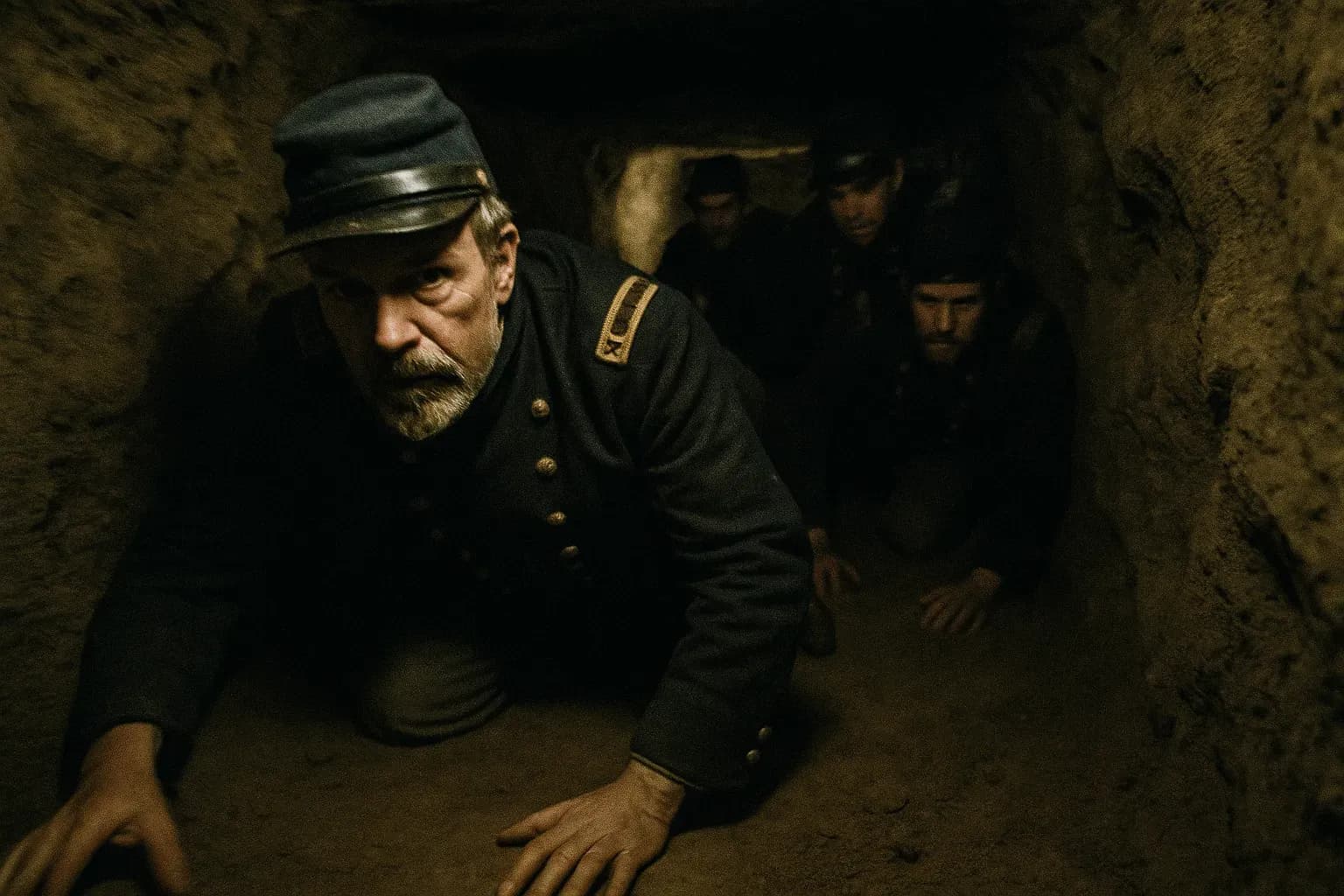
Working with Major Andrew G. Hamilton, a Kentucky cavalry officer, Rose devised an audacious plan: dig a tunnel. In the basement area known as "Rat Hell," the men found their starting point—a hole in the kitchen fireplace and stove that led downward. From there, they would need to dig roughly 50 to 60 feet through earth and stone, emerging in a tobacco shed in the warehouse yard on Canal Street.
Timeline
Capture at Chickamauga
Colonel Thomas E. Rose is captured by Confederate forces during the Battle of Chickamauga.
Arrival at Libby Prison
Rose arrives at the notorious Confederate prisoner-of-war camp Libby Prison in Richmond, Virginia.
The great escape
109 Union officers escape from Libby Prison through the tunnel dug by Rose and Hamilton. Guards do not discover the escape until nearly 12 hours later.
Prisoner exchange
After being recaptured, Colonel Rose is exchanged for a Confederate colonel and returns to the Union.
The engineering challenges were staggering. The tunnel was so cramped that sections measured just 16 inches wide—barely room for a man to squeeze through on his belly. The diggers worked with improvised tools, removing earth bit by bit while maintaining absolute secrecy. Guards patrolled constantly. Discovery meant execution or indefinite solitary confinement.
For 17 grueling days, teams of prisoners took turns digging, hauling earth, and shoring up the fragile passage. The work was backbreaking and dangerous. Tunnel collapses were a constant threat. Ventilation was minimal. Yet they pressed on.
By February 7, 1864, the tunnel was complete—at least enough to attempt. That's when Colonel Abel D. Streight tested it first, successfully crawling through to freedom. Two days later, on February 9, the full escape commenced.
Over the course of that night, 109 prisoners made their way through the narrow passage. They moved quietly, methodically, understanding that discovery would doom everyone still inside. The guards initially noticed nothing unusual. Nearly 12 hours passed before the prison alarm was finally raised—an almost incomprehensible security failure that made the escape's scale possible.
But freedom proved elusive for many. Of the 109 who escaped, only 59 successfully reached Union lines. The remaining prisoners faced a desperate race through Confederate territory. Forty-eight to 49 were recaptured. Two drowned, likely attempting to cross the James River or other waterways during their flight.
Colonel Rose himself, the architect of the escape, was among those recaptured before reaching safety. Yet his legacy endured. After the war, Rose was brevetted Brigadier General in July 1865, recognition of his courage and leadership. He lived until 1907, and was buried with full military honors in Arlington National Cemetery.
The Libby Prison escape remains one of the most remarkable episodes of the American Civil War—a testament to ingenuity, determination, and the human drive for freedom. Against impossible odds, in the heart of enemy territory, a handful of determined men dug their way out and took 100 others with them. It was, quite simply, a great escape.
**Sources:** https://en.wikipedia.org/wiki/Libby_Prison_escape https://www.history.co.uk/articles/the-libby-prison-escape-us-civil-war https://civilwarmonths.com/2024/02/09/the-daring-escape-from-libby-prison/ https://uncommonwealth.lva.virginia.gov/blog/2024/02/09/the-great-escape/ https://www.nps.gov/rich/learn/historyculture/colonel-thomas-e-rose.htm
Ask about this case
Answers from KrimiNyt's coverage onlyFollow this case
Get an email when a new documentary, podcast or book about The Great Escape: Colonel Rose's Tunnel Out of Libby Prison appears, or when a verdict is reached.