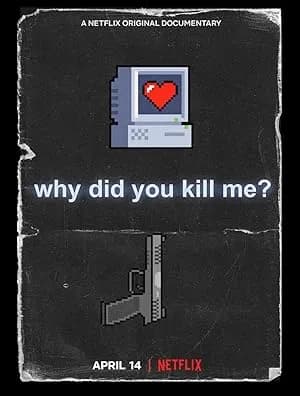
Why Did You Kill Me?
Netflix, 2021 — Murder of Crystal Theobald solved through Facebook vigilante justice
Quick facts
What Is the Series About?
Why Did You Kill Me? is a 2021 Netflix documentary directed by Fredrick Munk that examines one of the most unusual murder investigations in recent American true crime history. The film centers on the 2006 drive-by shooting death of Crystal Theobald, a 24-year-old woman from Riverside, California, and the extraordinary — and deeply controversial — steps her family took to identify and expose her killers. Rather than waiting for the justice system alone, Crystal's mother, Belinda Lane, and other relatives created fake Facebook profiles of attractive young women and used them to infiltrate the social media circles of suspected gang members. The documentary raises profound and uncomfortable questions about grief, vigilantism, justice, and the power — and danger — of social media as an investigative tool.
The Case
On the night of February 21, 2006, Crystal Theobald was riding in a vehicle through a neighborhood in Riverside, California, with members of her family. A car pulled alongside them, and gunfire erupted in what witnesses and investigators later described as a drive-by shooting carried out by members of the 5150 Bloods, a local street gang. Crystal was struck by gunfire and died from her wounds. She was 24 years old.
The shooting appeared to be a case of mistaken identity — the family's car had allegedly been confused with a rival gang vehicle. Crystal herself had no known gang affiliations. The randomness and senselessness of her death added a particularly devastating dimension to the loss felt by her family.
Riverside police investigated the case, but Crystal's family grew frustrated with what they perceived as slow progress. In a decision that would become the documentary's central and most debated element, Belinda Lane and Crystal's cousin, Jaimie, began constructing fake identities on Facebook. Posing as attractive young women, they friended and flirted with individuals they believed were connected to the 5150 Bloods. Over time, gang members began boasting online — sharing details, photos, and information that the family screenshotted and passed along to detectives.
The operation worked. The information gathered through the Facebook sting, combined with traditional police investigative work, led to the identification, arrest, and eventual conviction of multiple gang members. Julio Blanco Garcia and others were found guilty of offenses connected to the murder, receiving sentences that included 25 years to life in California state prison.
Yet the documentary does not present this as a simple triumph. Munk and the film's subjects grapple honestly with the complications of the family's vigilante approach — the way prolonged immersion in gang culture online began to affect some family members, and the question of whether the pursuit of justice had at times prolonged or deepened their trauma.
Production
The documentary was directed by Fredrick Munk, whose work focuses on emotionally complex, character-driven true crime stories. Munk was given extensive access to the Theobald and Lane family, including Belinda Lane herself, who speaks candidly and at times heart-wrenchingly about her daughter, her grief, and her decision to take matters into her own hands online.
The film makes strong use of home video footage, family photographs, and screenshots from the actual Facebook exchanges conducted during the sting operation. This primary material lends the documentary an immediacy and intimacy that distinguishes it from more conventionally assembled true crime productions. Law enforcement officials who worked the original case are also interviewed, offering perspective on how the family's digital operation intersected — sometimes awkwardly — with official police procedure.
Running as a single feature-length film rather than a multi-episode series, Why Did You Kill Me? maintains a focused, propulsive narrative pace. Munk is careful not to sensationalize the crime itself; instead, the emotional core of the film is the family's grief and the morally complex lengths to which love and loss drove them.
Reception
The documentary received a mixed-to-positive reception from critics and audiences upon its Netflix debut on April 14, 2021. On IMDb, the film holds a rating of approximately 6.5 out of 10, reflecting an engaged but divided audience response.
Critics largely praised the film's emotional authenticity and its willingness to complicate the audience's sympathy for the family's vigilante tactics. Several reviewers noted that the documentary resists the urge to be purely celebratory about the Facebook sting, instead allowing space for moral ambiguity. The Guardian and other outlets highlighted the film as a timely meditation on social media, justice, and the limits of institutional trust.
Some critics, however, felt that the film occasionally veered too close to the family's perspective without sufficient external challenge, and that certain ethical questions raised by the sting operation — including potential entrapment concerns and the psychological cost to family members who spent months embedded in gang social media culture — were not examined with the depth they deserved.
Viewers on social media were broadly engaged, with the film generating significant discussion on Twitter and Reddit upon release, particularly around the ethics of digital vigilantism and the way platforms like Facebook can be weaponized — for harm and, in this case, for a form of justice.
The Case Today
As of the time of the documentary's release and in the years since, the convictions secured in the Crystal Theobald murder case have stood. The individuals convicted remain incarcerated, serving their sentences in the California state prison system.
The case has become a landmark reference point in discussions about social media and crime-solving — cited in journalism, academic research, and law enforcement training contexts as an early and dramatic example of how platforms like Facebook could be used both by families desperate for answers and by investigators seeking digital leads.
For Belinda Lane and the Theobald family, the Netflix documentary brought a measure of wider recognition for Crystal's life and for the lengths her family went to in pursuit of justice. In interviews connected to the film's release, Lane expressed that while no conviction could return her daughter, she hoped the story might resonate with other families left behind by violent crime and under-resourced investigations.
The broader questions the documentary raises — about grief, vigilantism, the reliability of social media evidence, and the line between helping investigators and obstructing due process — remain as relevant today as when Crystal Theobald was killed on a Riverside street in 2006.