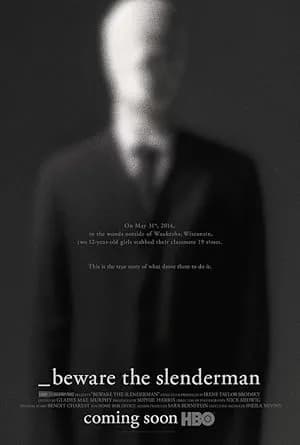
Beware the Slenderman
HBO Max, 2016 — The documentary covering the 2014 Waukesha Slender Man stabbing
Quick facts
What Is the Series About?
Beware the Slenderman is a feature-length HBO documentary directed by Irene Taylor Brodsky that examines one of the most disturbing crimes to emerge from the age of internet mythology: the 2014 Slender Man stabbing in Waukesha, Wisconsin. The film premiered at South by Southwest in March 2016 and aired on HBO on January 23, 2017. It is available to stream on HBO Max and was catalogued on IMDb under title ID tt5329376.
Rather than functioning as a simple crime recap, the documentary situates the attack within the broader cultural landscape of internet creepypasta folklore, adolescent psychology, and parental anxiety about children's unsupervised digital lives. It asks — without offering easy reassurance — how two ordinary 12-year-old girls came to believe that a fictional online monster was real enough to kill for.
---
The Case
On May 31, 2014, twelve-year-olds Morgan E. Geyser and Anissa E. Weier lured their classmate Payton Isabella Leutner — also known as Payton "Bella" Leutner — into a wooded area of Davids Park in Waukesha, Wisconsin, and stabbed her 19 times. The attack had been premeditated: the girls told investigators they believed that by killing Leutner they would become "proxies" — servants — of Slender Man, a tall, faceless supernatural figure that originated as a 2009 internet meme on the forum Something Awful and subsequently spread across horror fan communities.
Leutner survived the attack by crawling out of the woods to a nearby road, where she was discovered by a passing cyclist. She was airlifted to a hospital and treated for wounds that came within a millimetre of her heart. Police arrested Geyser and Weier the same day.
Both girls were initially held in juvenile custody but were charged as adults with attempted first-degree intentional homicide. If convicted on that charge, they each faced up to 65 years in prison. The case generated immediate and intense national coverage, driven by the perpetrators' young age, the fantastical motive, and the unprecedented question of whether exposure to internet horror content could function as a criminal catalyst.
During police questioning — footage and transcripts of which are incorporated into the documentary — the girls stated plainly that they had attacked Leutner to appease Slender Man, whom they genuinely believed to be a real entity capable of harming their families if they did not comply with his demands. Mental health evaluations subsequently indicated that Geyser suffered from early-onset schizophrenia, a diagnosis that would become central to her legal defense.
In December 2017, Anissa Weier was sentenced to 25 years of involuntary commitment in a psychiatric institution after pleading guilty to a lesser charge. Months later, Morgan Geyser received a sentence of 40 years in a psychiatric facility — the maximum available under Wisconsin's juvenile mental health commitment statutes. Neither received a traditional prison sentence; both dispositions reflected the courts' conclusions that mental illness was the primary driver of the crime.
Payton Leutner recovered physically from her injuries. She has since spoken publicly about the attack, including in a 2019 television interview.
---
Production
Director Irene Taylor Brodsky, whose previous work included the Emmy-winning documentary Hear and Now (2007), spent roughly two years gaining access to the families at the center of the case. The documentary features extensive interviews with the parents of both Geyser and Weier — people grappling simultaneously with the horror of what their daughters had done and their own grief, confusion, and guilt.
Brodsky also draws on police interrogation footage, court documents, and deep-dive reporting on the Slender Man mythos itself — interviewing folklorists, internet researchers, and experts in adolescent psychology to construct a layered argument about how a digital legend migrated off a screen and into an act of real-world violence. The film includes animated sequences that recreate the aesthetic of online Slender Man lore, giving viewers a visceral sense of the imagery that had saturated the girls' imaginations.
By weaving together the intimate family portraits with the broader cultural analysis, Brodsky deliberately avoids treating the case as a simple morality tale. The result is a film that is as much about the internet's power to reshape a child's perception of reality as it is about a crime.
---
Reception
Critical response to Beware the Slenderman was broadly positive. According to Wikipedia, the film holds an 85% approval rating on Rotten Tomatoes and a 78 out of 100 on Metacritic, reflecting strong consensus among professional reviewers.
The Atlantic described it as a film with "no easy answers," praising Brodsky's refusal to reduce the case to a simple narrative of villainy or victimhood, and emphasizing the documentary's focus on psychological and social factors rather than lurid crime reconstruction. The Los Angeles Times characterized it as a "chilling look" at a crime inspired by Slender Man, noting the film's effectiveness in conveying the strangeness and tragedy of the case. Vice went further, calling it a "true crime horror movie" and highlighting the way it weaponizes the aesthetics of internet horror against the viewer.
Controversy around the documentary was significant. Critics and audiences raised ethical concerns about whether a film profiling the inner lives of two child perpetrators risked humanizing them at the expense of their victim. Others questioned whether extensive media coverage of the Slender Man mythology — including this documentary — served to amplify and legitimize a harmful internet subculture. The film's decision to center largely on the families of the perpetrators rather than on Leutner and her family drew particular scrutiny.
Additionally, the case itself raised lasting questions about the responsibility of internet platforms to moderate content consumed by children, and about how parents can monitor and contextualize the digital environments their children inhabit — questions the film poses but leaves deliberately unanswered.
---
The Case Today
As of the documentary's production and contemporaneous reporting, both Geyser and Weier remain under long-term psychiatric commitment as a result of their 2017–2018 sentences. Morgan Geyser's 40-year commitment and Anissa Weier's 25-year commitment are subject to periodic review under Wisconsin law, meaning either could potentially be released earlier if deemed no longer a danger — though that determination would require formal court proceedings.
Payton Leutner, who was approximately 12 years old at the time of the attack, has spoken publicly about her survival and her path forward. The Slender Man character itself has continued to circulate in internet culture, spawning video games, a 2018 theatrical horror film, and ongoing fan communities — a fact that has kept the ethical questions raised by this documentary perpetually relevant.
Beware the Slenderman remains one of the most widely discussed true crime documentaries of the 2010s, not only for the shocking nature of the underlying case but for the serious cultural and psychological questions it raises about children, the internet, and the blurring line between fiction and belief.