Cops
Pluto TV / Roku / Samsung / LG, 1989 — unscripted U.S. law enforcement documentary series
Quick facts
What Is Cops?
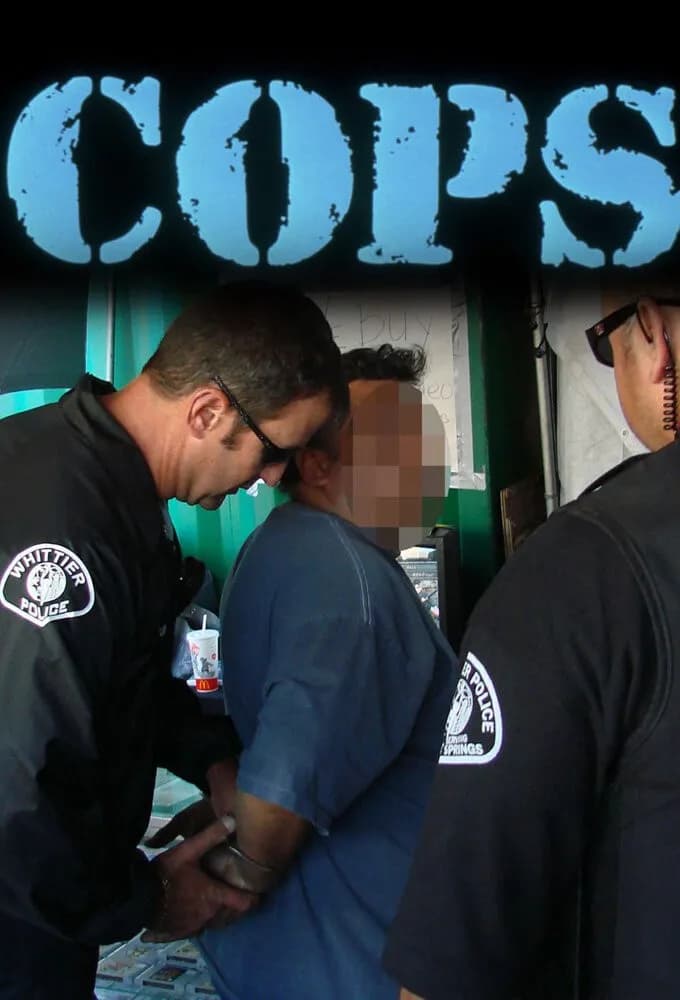
Cops is one of the most recognizable and enduring documentary television series in American history. Premiering on Fox on March 11, 1989), the show broke new ground by embedding camera crews directly with law enforcement officers as they conducted their daily patrols, responded to emergency calls, made arrests, and carried out undercover stings. Unlike narrative true-crime series that reconstruct a single case, Cops is an episodic, unscripted documentary — a fly-on-the-wall record of thousands of real interactions between police and the American public, filmed in cities and towns across the United States over more than three decades.
Produced by Langley Productions, the series has aired more than 1,000 episodes across 37 seasons, making it one of the longest-running primetime shows in U.S. television history. Today, the complete back catalogue is available to stream for free on Pluto TV, The Roku Channel, Samsung TV Plus, and LG Channels — placing it within reach of tens of millions of cord-cutting viewers without a subscription.
Format and Content
The defining feature of Cops is its radical simplicity. There is no narrator, no dramatic re-enactment, no expert commentary, and no courtroom footage. Each episode accompanies law enforcement officers — from patrol deputies and detectives to drug enforcement agents — through their shifts, capturing whatever unfolds in real time. Incidents range from domestic disturbance calls and traffic stops to high-speed pursuits, drug busts, and violent confrontations.
The series has filmed with departments in dozens of jurisdictions, including Los Angeles, Miami, Kansas City, Las Vegas, and Maricopa County, among many others. This geographic breadth gives the series a panoramic view of American policing — its routines, its dangers, and its ambiguities — rather than the focused narrative of any single criminal case.
Because Cops documents hundreds of individual incidents rather than one central crime story, it does not have a single perpetrator, victim, or verdict to describe. The individuals who appear in the show are arrested suspects — many of whom are later acquitted or have charges reduced — and their identities and outcomes vary across thousands of segments filmed over 35-plus years.
Production
Langley Productions, founded by John Langley and Malcolm Barbour, developed the Cops format at a moment when American network television was searching for cheaper, more immediate alternatives to scripted programming. The result was a show that cost a fraction of conventional drama to produce but delivered an authenticity that scripted content could not replicate.
Camera operators and producers embedded with police departments under ride-along agreements, often spending weeks with a single unit before an episode was assembled in the editing room. The series used handheld cameras and natural lighting, a style that would later influence an entire generation of reality television, from Live PD to Border Security. The absence of a narrator was a deliberate creative choice: viewers were invited to draw their own conclusions from what they witnessed.
Over the decades, the show cycled through multiple broadcast homes. It launched on Fox, moved to Spike TV (later Paramount Network), and returned to Fox before landing on Fox Nation and, eventually, free ad-supported streaming platforms where it continues to attract large audiences.
Reception
Cops holds an IMDb rating of 6.9/10) — a respectable score for a show that has run for over three decades and encompasses enormous variation in content quality and incident severity. Critics and cultural commentators have long debated its merits and its impact.
On the positive side, the series has been credited with pioneering the reality television genre, demonstrating that unscripted, documentary-style programming could command large primetime audiences. Its raw, unmediated footage gave many viewers their first extended look at the daily realities of law enforcement work — the tedium, the unpredictability, and the genuine danger that officers face.
However, Cops has also attracted sustained and serious criticism. Scholars, civil rights advocates, and media critics have argued that the series systematically frames low-income individuals and people of color as criminals, presenting arrests as proof of guilt and rarely following up on the legal outcomes of the cases it films. Because the show by design excludes context — there is no backstory, no defense perspective, no follow-up — viewers are left with a skewed portrait of crime and policing that critics argue reinforces racial and class biases.
The series also became the subject of scrutiny for its editorial process: participants who are filmed during arrests must sign release forms, but the power dynamics in those moments have been questioned, and individuals who are later acquitted have little recourse to have their footage removed from syndication.
Controversy and Cancellation
The most significant rupture in the show's history came in June 2020. Following the death of George Floyd and the nationwide protests that ensued, both Fox and Paramount Network announced they would cease producing new episodes of Cops, citing concerns about the show's portrayal of policing and its perceived insensitivity to questions of racial justice and police brutality.
The cancellation was widely reported as a watershed moment — not just for Cops itself, but for the broader genre of police ride-along programming. A&E simultaneously cancelled Live PD, another highly rated law enforcement documentary series.
The pause in production did not last permanently. Cops was subsequently revived, continuing into Season 37 by 2026. The revival itself generated debate, with supporters arguing the show provides valuable transparency into police work and critics contending that the fundamental editorial problems that led to its cancellation had not been addressed.
Where to Watch
For viewers interested in exploring the Cops archive, the series is currently available at no cost on several major free streaming platforms. Pluto TV carries multiple seasons, organized by season and episode, making it easy to browse specific departments or time periods. The Roku Channel, Samsung TV Plus, and LG Channels similarly carry the series as part of their free, ad-supported true crime and documentary libraries.
Legacy
Few television programs have had as complex and contested a legacy as Cops. It is simultaneously a genuine documentary landmark — one of the first shows to bring unscripted, verité-style filmmaking to primetime American television — and a deeply polarizing artifact of how media shapes public understanding of crime, race, and justice. Whether viewed as an essential document of American law enforcement or as a problematic entertainment product that exploits vulnerable people at their worst moments, Cops remains an unavoidable reference point in any serious discussion of true crime television and its relationship to the justice system it depicts.