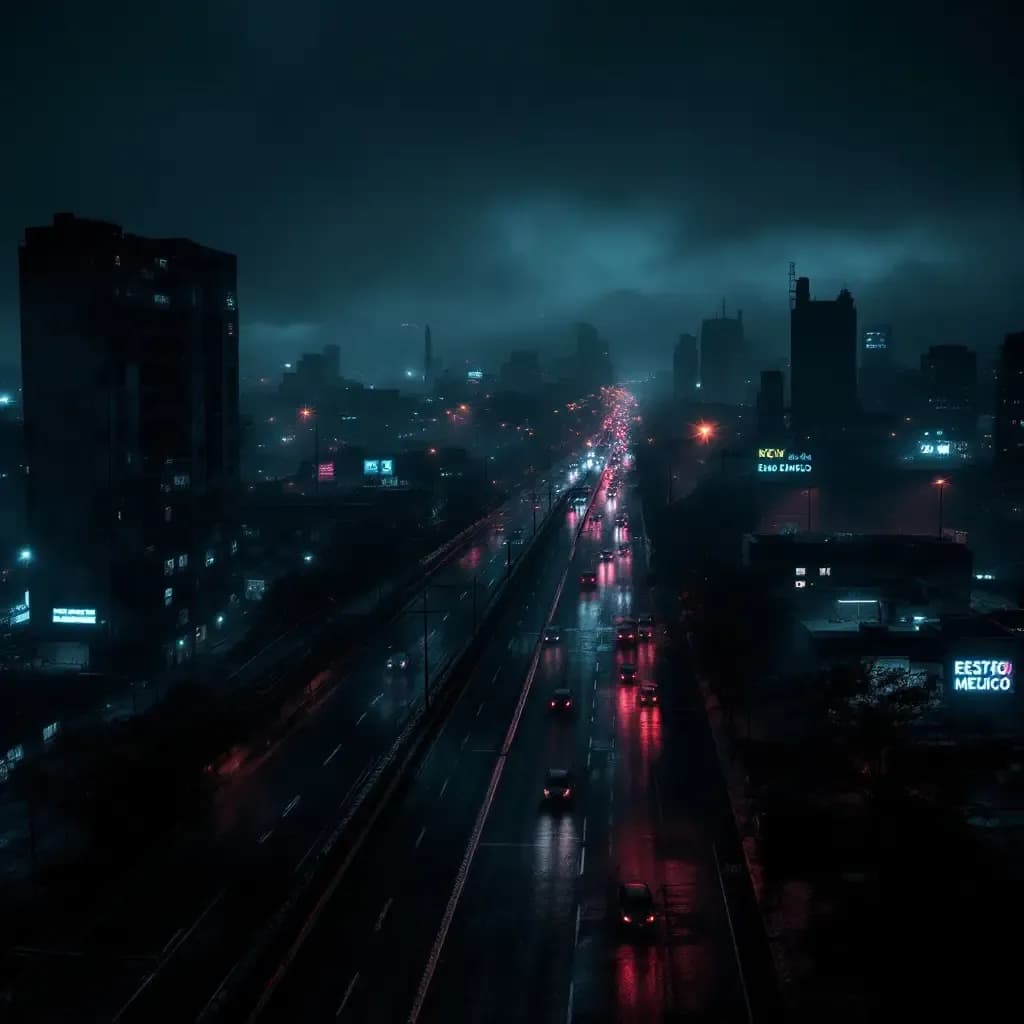
Archivo Negro: Sombras del Crimen
ViX, 2024 — Five true crime cases from Mexico City and the Estado de México
Quick facts
What Is the Series About?
Archivo Negro: Sombras del Crimen is a ViX original anthology true crime documentary series that premiered on June 13, 2024. Rather than focusing on a single case, the series takes an anthological approach, dedicating each of its five episodes — each running approximately 50 minutes — to a distinct real criminal case drawn from Mexico City and its metropolitan area. The result is a mosaic portrait of violent crime in one of Latin America's largest urban centers, examining not just the crimes themselves but the social conditions that allow them to flourish.
Produced by ViX, N+ Docs, and Detective, and directed by five different filmmakers — Emiliano Altuna, Paulina del Paso, Diego Moreno Garza, Liora Spilk Bialostozki, and José Villalobos — the series was designed from the ground up to offer what its creators describe as "unknown details" and "a new perspective on criminality and its roots in the social fabric" of contemporary Mexico.
The Cases
Because Archivo Negro is an anthology, each episode functions as a self-contained documentary film. While the full details of all five episodes have not been widely published, the series' official trailer and promotional materials confirm that every case is drawn from real, high-impact crimes that shook the Mexican capital and its surrounding municipalities.
Episode 1: "La Jefa"
The first episode, titled "La Jefa" (The Chief), is the most thoroughly documented of the five. It centers on a case of serial femicide — the targeted serial murder of women — whose victims' bodies began appearing along the border between Mexico City and the Estado de México. The episode's title does not refer to the killer, but rather to the female police officer who led the investigation that ultimately resulted in the perpetrator's capture. Her team's work forms the dramatic spine of the episode.
The specific identity of the serial killer has not been disclosed in publicly available promotional materials or press coverage. Similarly, the names of the victims have not been published in connection with the series — an editorial choice that may reflect both legal considerations and a desire to center the narrative on the investigators and the structural conditions enabling femicide rather than on sensationalized details of the crimes themselves.
What is confirmed is that the killer was captured by the police team led by "La Jefa," bringing an active threat to a close. The Estado de México — which borders Mexico City to the north, west, and east — has been one of the regions with the highest rates of femicide in Mexico for over a decade, making this case emblematic of a broader national crisis.
Episodes 2–5
The remaining four episodes each cover a separate high-impact crime from the Mexico City metropolitan area. The specific perpetrators, victims, and case details for these episodes have not been detailed in publicly available sources at the time of publication. According to the N+ Docs explanation of the series, each episode was directed by a different filmmaker, giving the anthology a varied stylistic and narrative approach across its five chapters.
Production
The series represents a collaboration between ViX — the Spanish-language streaming platform owned by TelevisaUnivision — and N+ Docs, the documentary division of Noticias Televisa, alongside production label Detective. The involvement of N+ Docs signals a journalistic pedigree: the unit has been responsible for some of Mexico's most high-profile investigative documentary productions in recent years.
The decision to assign a different director to each episode was deliberate. By pairing individual filmmakers with individual cases, the producers allowed each story to be told in the cinematic language most suited to it, rather than imposing a single house style across the anthology. The result is a series that functions both as journalism and as documentary filmmaking.
According to producers who spoke at the International Film Festival in Guadalajara, the series gained access to investigators, first responders, and in some cases individuals directly connected to the crimes — a level of access that distinguishes it from purely archive-driven true crime productions. Protagonist Italy Ciani was among those who appeared at the festival to discuss the show's themes and production process.
Reception
The series is available on ViX and has also been distributed through Univision and Atresplayer, extending its reach to Spanish-speaking audiences across the Americas and Europe. Its presence on Apple TV channels further broadens its international availability.
The series holds an IMDB listing under ID tt32613410, though a specific numerical rating has not been widely reported in available sources at the time of publication. Critical discourse around the series has focused primarily on its anthological structure and its willingness to examine the systemic roots of crime — corruption, gender violence, and institutional failure — rather than simply recounting criminal acts for shock value.
No major controversies surrounding the series have been reported in available press coverage.
The Case Today
The serial femicide case featured in "La Jefa" resulted in the capture of the perpetrator, as confirmed by the episode's narrative. However, details regarding the killer's trial, sentencing, or current incarceration status have not been made publicly available in connection with the series' release. The broader context in which the case occurred — the epidemic of femicide along the Mexico City–Estado de México border — remains an active and urgent public concern in Mexico, with civil society organizations and journalists continuing to document cases and pressure authorities for systemic reform.
For Mexican true crime audiences and international viewers alike, Archivo Negro: Sombras del Crimen stands as a serious, multi-voiced attempt to grapple with the criminal landscape of one of the world's most complex megacities — five cases, five directors, and one unflinching lens on the darkness at the edges of urban life.