True crime news logo
  • News

Sign up for our newsletter and get the latest stories

Never miss the latest true crime news, reviews and top lists — plus new podcasts, series, films and books.

You can unsubscribe with one click from any email.

True crime news logo

The international true crime destination. Cases, documentaries, podcasts and travel routes.

© 2026 truecrime.news. All rights reserved.

American Greed exposes the dark world of financial crime

American Greed: How CNBC Documents White-Collar Crime

A decade-long television series exposing Ponzi schemes, fraud, and corporate scandals across America

Published
May 26, 2025 at 10:00 PM

CNBC's American Greed, also known as American Greed: Scams, Scoundrels and Scandals, debuted in 2007 as a documentary television series dedicated to exposing the financial crimes that devastate families and corporations alike. The show combines interviews with police investigators, fraud victims, and—in some cases—the perpetrators themselves to tell the stories behind America's most notorious white-collar crimes.

The series cast a wide net across the landscape of American financial fraud. Early episodes profiled cases like Gerald Barnes, a man who impersonated a physician for two decades, founding a lucrative medical practice specializing in executive health examinations while earning a six-figure salary. Aired on June 28, 2007, that same episode also documented the Interstate Bank Mart Bandit, who carried out 43 robberies across a 20-month period using an identical modus operandi while leaving virtually no evidence behind.

As the series progressed, American Greed tackled increasingly complex schemes. One notable case involved Rico Vendetti, the boss of an organized retail crime ring that targeted major big-box retailers, stealing goods that were resold online—operations that moved approximately $700,000 in merchandise before law enforcement caught up. The episode highlighted the broader context: organized shoplifting and retail theft generates an estimated $30 billion annually across the United States.

Violent crimes intertwined with financial motivation also appeared in the series. The case of Nanette Johnston, for instance, revealed how she manipulated a lover into murdering her "sugar daddy," allowing her to steal approximately $250,000 and position herself to inherit a beach house, car, and trustee role controlling an additional $1.2 million.

Perhaps no case better illustrated the intersection of corporate power and callous disregard for human life than the profile of Martin Shkreli, the pharmaceutical executive dubbed "Pharma Bro." When Shkreli's company acquired rights to a lifesaving HIV medication, he raised its price by 5,000 percent overnight. The February 26, 2018 episode captured Shkreli's arrogance—including his penchant for internet trolling—and exposed the shady accounting practices underlying his hedge fund and pharmaceutical ventures.

American Greed also frequently contextualized individual cases within larger corporate scandals. The series referenced the Enron collapse, where accounting fraud triggered $78 billion in stock losses, the destruction of 5,000 jobs, and wiped-out employee pensions. Sherron Watkins, an Enron employee, became a whistleblower in 2001. The resulting litigation yielded a $7.185 billion class action settlement, though former Enron president Jeff Skilling's initial 24-year sentence was later reduced by 10 years.

Similarly, the WorldCom scandal emerged from accounting fraud totaling $11 billion. VP Cynthia Cooper exposed the fraud in 2002, leading to a $750 million civil penalty and the conviction of CEO Bernie Ebbers.

Recognizing audience appetite for active investigations, CNBC launched American Greed: The Fugitives in August 2012 as a spin-off series. This version focused specifically on white-collar crime cases where suspects remained at large, covering 13 cases across its two-season run.

From impostor professionals to pharmaceutical executives, from organized retail theft rings to murder-for-hire schemes, American Greed documented the breadth of financial crimes in contemporary America. The series demonstrated that white-collar crime—often involving millions of dollars and affecting thousands of victims—deserves the same investigative scrutiny and public accountability as any other criminal enterprise.

**Sources** - https://en.wikipedia.org/wiki/American_Greed - https://www.investmentzen.com/news/10-worst-cases-of-corporate-greed-in-us-history - https://www.youtube.com/watch?v=KBU31FJ4ymc - https://www.youtube.com/watch?v=-lc1mxP3Cd8 - https://en.wikipedia.org/wiki/List_of_American_Greed_episodes

Read more

Dirty Billions expose money laundering at Danske Bank
Book

Danske Bank's $230 Billion Money Laundering Scandal

In God We Trust reveals Madoff's deceitful empire
Film

How a Secretary Exposed Madoff's $65 Billion Fraud

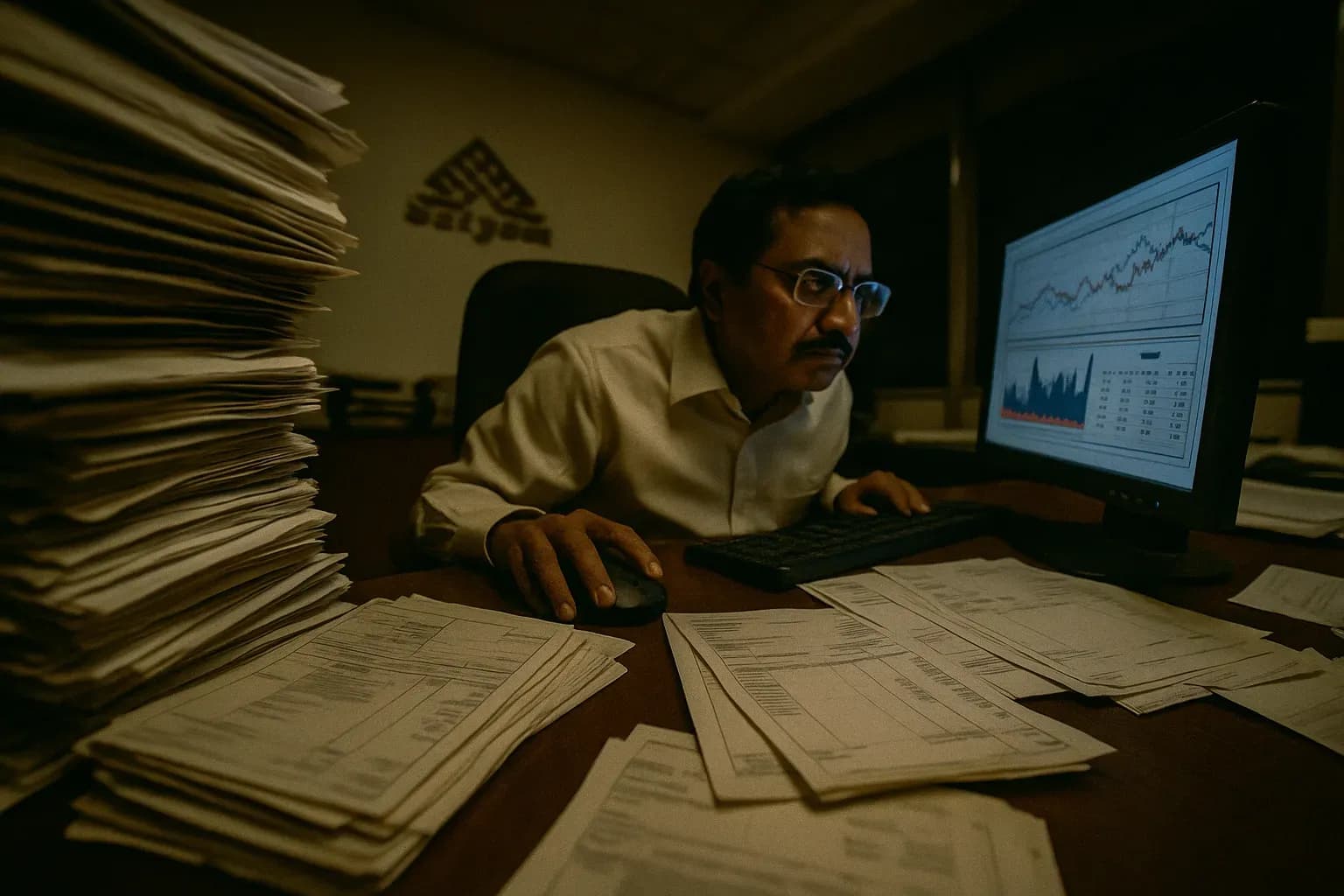
A cluttered office desk with stacks of forged invoices and documents, featuring a figure resembling B. Ramalinga Raju, focused intently on a computer screen displaying manipulated financial data at Satyam Computer Services.
Case

Satyam: How India's IT Giant Hid $1 Billion in Fraud

Related Content
Dirty Billions expose money laundering at Danske Bank

Danske Bank's $230 Billion Money Laundering Scandal

In God We Trust reveals Madoff's deceitful empire

How a Secretary Exposed Madoff's $65 Billion Fraud

A cluttered office desk with stacks of forged invoices and documents, featuring a figure resembling B. Ramalinga Raju, focused intently on a computer screen displaying manipulated financial data at Satyam Computer Services.

Satyam: How India's IT Giant Hid $1 Billion in Fraud

A computer screen displays Binance's cryptocurrency dashboard, a red alert notification flashing next to the balance showing a missing 7,000 bitcoin, symbolizing the massive cyberattack that rocked the exchange.

Hackers Steal $570 Million in Binance Coin Cyberattack

Advertisement
SS

Susanne Sperling

View all stories →
Share this post: