The Albino Murders: The Bloody Price of Superstition in Africa
Brutal killings and mutilations of people with albinism in East Africa — their body parts sold for fortunes, driven by deep-rooted superstition
Published June 6, 2025
Case Details
Quick Facts
Quick facts
On December 9, 2008, shortly after two in the afternoon, 14-year-old Matatizo Dunia left his home in the village of Bukombe in Tanzania's Shinyanga region to fetch water. He never returned. The boy, who had albinism, was attacked by three men who hacked off his limbs with a machete and left his mutilated body in a bush.
This brutal murder was not an isolated incident. It was part of a systematic wave of violence and persecution that has plagued East Africa since 2006.
A Systematic Wave of Violence
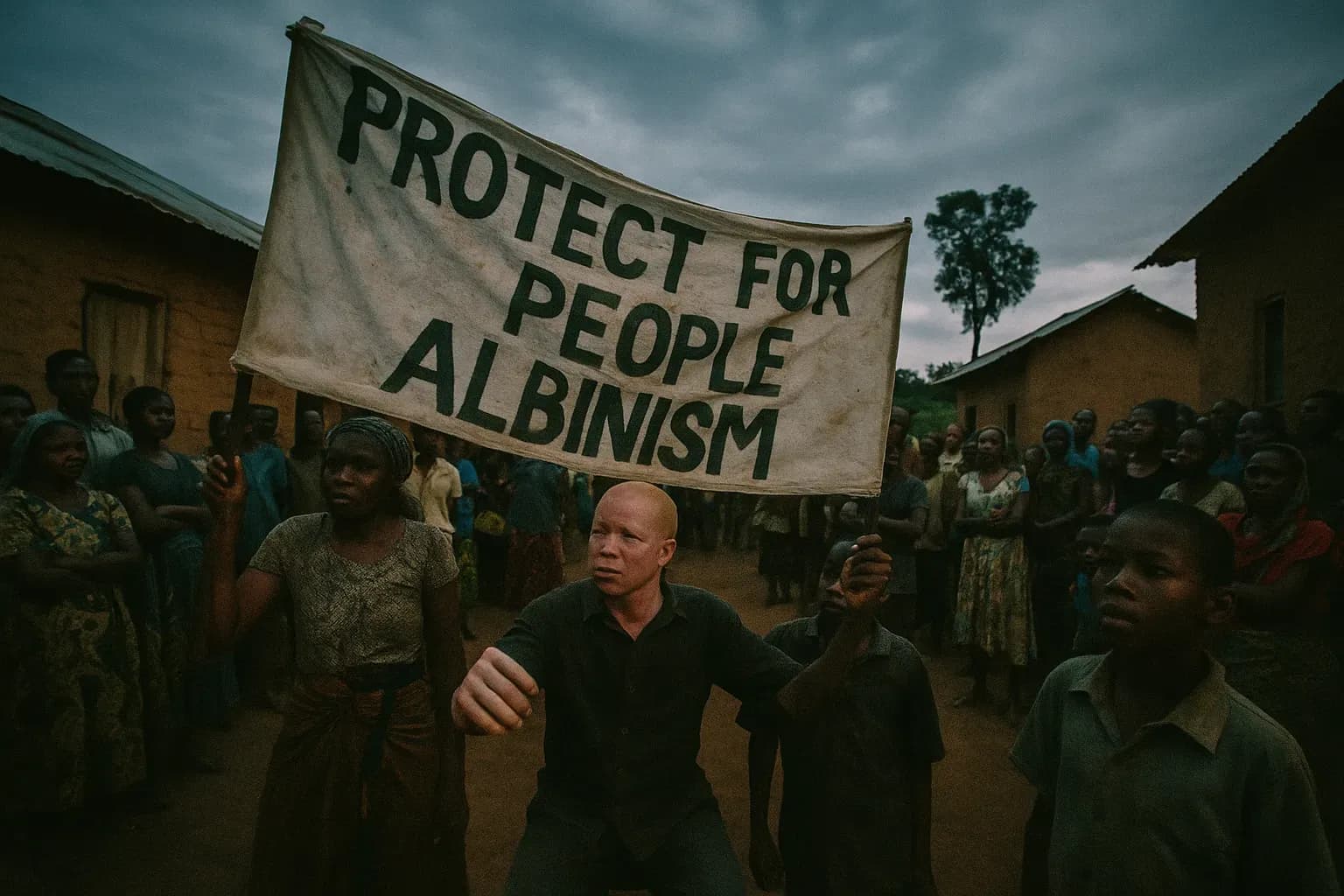
In Tanzania alone, at least 54 people with albinism were murdered between 2007 and 2009, primarily in the country's northwestern regions. A similar wave of violence hit Malawi from 2015 onward, where at least 100 attacks on people with albinism were recorded within just a few years. Victims — both children and adults — had their body parts sold on a grim black market, driven by deeply entrenched superstition.
Timeline
The beginning of the systematic wave of violence
In East Africa, a documented wave of attacks on people with albinism begins, driven by superstition and profit motives.
Escalation in Tanzania
Between 2007 and 2009, at least 54 people with albinism are murdered in Tanzania alone, mainly in the northwestern regions.
The murder of Matatizo Dunia
14-year-old Matatizo Dunia is attacked and murdered in Bukombe, Tanzania. His limbs are hacked off with a machete.
Undercover investigation exposes trade
Tanzanian journalist Vicky Ntetema reveals through undercover investigation how witch doctors openly offer body parts from people with albinism.
Mariam survives attack by her own father
Eight-year-old Mariam from the Mwanza district is attacked by her father, who attempts to sell her arm. She survives severely injured.
The wave of violence reaches Malawi
From 2015, at least 100 attacks on people with albinism are documented in Malawi within just a few years.
UN day for albinism awareness
The United Nations declares June 13 as International Albinism Awareness Day to draw attention to the violence.
This pattern of ritual killings represents one of the most disturbing human rights crises in the African Great Lakes region.
Superstition and $75,000: The Black Market for Body Parts
Behind the murders lies a toxic combination of superstition and cynical economic exploitation. According to local folk beliefs — particularly prevalent among certain communities in Tanzania — people with albinism are regarded as ghosts or "the cursed." Their body parts are believed to hold magical powers, a notion exploited by a profitable underground industry specializing in the trafficking of human remains.
A single arm or leg could fetch up to $75,000 on the black market, according to police estimates. So-called witch doctors, or traditional healers, play a central role in this macabre trade and its associated rituals.
In 2008, Tanzanian journalist Vicky Ntetema revealed through an undercover investigation how these healers openly offered body parts from people with albinism to wealthy clients. "It is often politicians or businesspeople seeking the power to secure electoral victory or financial gain," an anonymous source explained. Among the most disturbing practices allegedly involved burying wealthy individuals alongside four living people with albinism to ensure prosperity in the afterlife.
A Father's Betrayal: The Story of Mariam
Among the many harrowing cases is that of eight-year-old Mariam from the Mwanza district of Tanzania. In 2010, she was violently attacked by her own father, who attempted to sell her right arm to a witch doctor. Mariam miraculously survived, but required multiple surgeries.
Her mother, Amina, recounted: "My husband was tempted by money. He said that with the 500,000 shillings we could build a new house. But why should our daughter's life be the price?"
This type of crime — in which a family member is the perpetrator — illustrates how deeply the trade has corrupted communities, turning family violence into a calculated act for financial gain.
In Malawi, survivors of such attacks went on to become advocates for the rights of people with albinism. Yet even that path carried danger — several activists were found murdered in unsolved cases that sent shockwaves through local communities.
Justice: Convictions in Tanzania and Malawi's Fight
Tanzania's government initially responded slowly to the escalating crisis. It was not until 2009, under significant international pressure, that President Jakaya Kikwete banned witch doctors and launched a national action plan.
A landmark moment in the pursuit of justice came on September 23, 2009, when the High Court in Shinyanga sentenced three men to death for the murder of Matatizo Dunia. The ruling was among the first of its kind in cases involving the murder of people with albinism in Tanzania.
"This is only the beginning. There are many families still waiting for justice," said Ernest Kimaya of the Tanzania Albino Society following the verdict.
Malawi later followed with a four-year national action plan in 2018, focusing on protection, prosecution and education. Around 2017, courts in Malawi handed down prison sentences for crimes against people with albinism, including grave robbing — the exhumation of bodies to steal body parts for ritual use. Judges emphasized that such crimes require exemplary punishment to send a clear message to society.
International Attention and UN Action
International attention and action gradually followed. Canadian Peter Ash, himself born with albinism, founded the organization Under The Same Sun in 2009 after reading about the crisis. "I could not sit still in Canada while my fellow human beings were being slaughtered," he explained.
Under The Same Sun played a central role in documenting more than 200 attacks and murders in East Africa and pressured the United Nations human rights system to act. This contributed to the UN Human Rights Council adopting resolution 23/13 in 2013, calling on states to protect the human rights of people with albinism.
The Fight Continues
Despite these advances, the struggle for safety and human rights is far from over. In Tanzania, around 16,000 people with albinism continue to live under constant threats of violence. In Malawi, police recorded numerous cases of grave robbing between 2015 and 2023, with the bodies of people with albinism desecrated to steal body parts for superstition-based rituals.
There are, however, signs of hope. Tanzania's government has launched a strategy focused on healthcare, education and rights protection. Local activists in Malawi have organized watch groups to protect children with albinism on their way to school.
"We have seen signs of improvement since 2020, but the fight is far from over," activists in the region note.
The albino murders in Tanzania and Malawi expose a brutal reality in which superstition and greed result in human trafficking and tragic killings. Through the courage of local activists, international efforts and criminal prosecutions, a path toward lasting justice is slowly beginning to take shape. Every person with albinism deserves to live in dignity and freedom.
Ask about this case
Answers from KrimiNyt's coverage onlyFollow this case
Get an email when a new documentary, podcast or book about The Albino Murders: The Bloody Price of Superstition in Africa appears, or when a verdict is reached.