Martin Shkreli: From Pharma CEO to Federal Prison
How a controversial drug price hike made headlines, but securities fraud sent him to jail
Published June 6, 2025
Quick Facts
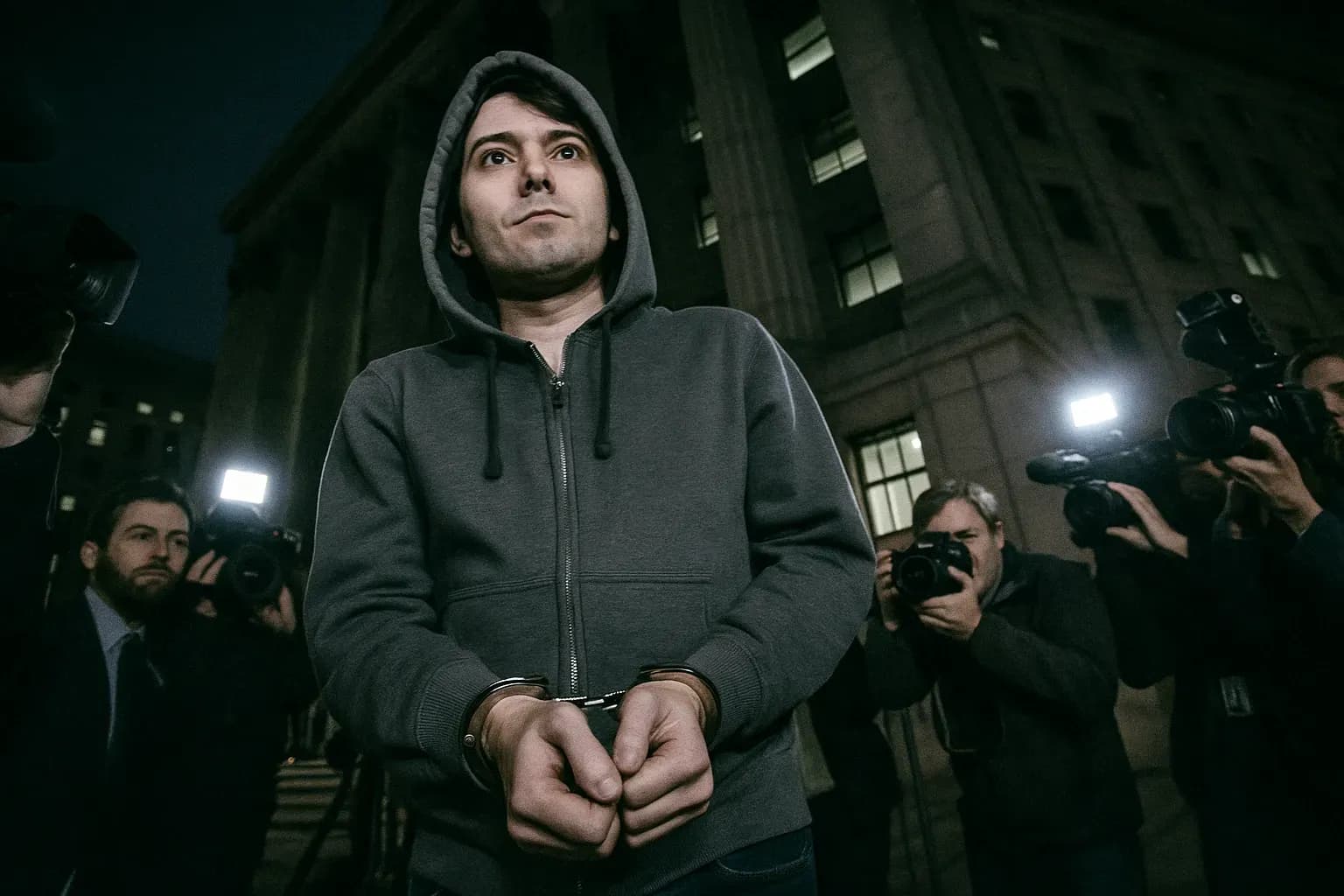
Martin Shkreli walked into a federal courtroom in Brooklyn on August 4, 2017, as a convicted securities fraudster. The pharmaceutical executive's conviction marked the climax of a case that had captivated the American public—though not entirely for the reasons that made him infamous.
Shkreli's notoriety stemmed largely from August 2015, when his company Turing Pharmaceuticals raised the price of Daraprim, an antiparasitic medication, from between $13.50 and $17.50 per pill to $750 per pill. The increase of approximately 4,000 to 5,000 percent triggered a firestorm of public outrage and media attention. Congressional hearings followed. Shkreli became the face of everything wrong with pharmaceutical pricing in America.
Yet the legal reckoning that finally caught up with him had nothing to do with that price increase. In fact, the dramatic markup was entirely legal. Instead, prosecutors in the Eastern District of New York pursued Shkreli on two counts of securities fraud and one count of conspiracy—charges related to his management of hedge funds and misrepresentations made to investors at a company called Retrophin.
Timeline
Turing Pharmaceuticals buys Daraprim and raises price
In August 2015, Shkreli's company Turing Pharmaceuticals acquires the rights to Daraprim. The price is raised from $13.50–15 to $750 per tablet.
Jury verdict: guilty on three counts
On August 4, 2017, a jury in Brooklyn finds Shkreli guilty on two counts of securities fraud and one count of conspiracy to commit securities fraud. Acquitted on the remaining counts.
Sentence: seven years in prison and $7.3 million forfeiture
On March 9, 2018, Judge Kiyo A. Matsumoto sentences Shkreli to seven years in prison, a $75,000 fine, and forfeiture of $7.3 million.
Civil verdict: lifetime ban and repayment of $64.6 million
On January 14, 2022, Judge Denise Cote in Manhattan imposes on Shkreli a lifetime ban from the pharmaceutical industry and repayment of $64.6 million in unlawful profits.
Second Circuit upholds lifetime ban and civil verdict
In January 2024, the Second Circuit Court of Appeals upholds the lifetime industry ban and the civil verdict against Shkreli in full.
On March 9, 2018, Judge Kiyo A. Matsumoto handed down the sentence: seven years imprisonment, plus three years of supervised release. Shkreli was also ordered to pay $75,000 in fines, forfeit $7.4 million, and face civil antitrust penalties of $64.6 million.
Shkreli maintained his innocence and appealed the conviction. In 2019, the U.S. Court of Appeals for the Second Circuit unanimously affirmed the conviction, rejecting his challenge.
While serving his sentence at Allenwood, a low-security federal prison in Pennsylvania, Shkreli's seized assets became part of an unusual legal footnote. The government auctioned off items from his collection, including the Wu-Tang Clan's enigmatic album "Once Upon A Time in Shaolin," which sold for $4 million in July 2021, along with other music and art.
Shkreli's incarceration lasted roughly four years. He was released early in May 2022, though the conviction carried consequences that extended beyond prison walls. He received a permanent ban from serving as an officer or director of any publicly traded company—a sanction designed to keep him out of corporate leadership indefinitely.
His co-defendant, Evan Greebel, a 44-year-old from Scarsdale, New York, was also implicated in the fraud scheme.
The Shkreli case remains a landmark in white-collar criminal prosecution, but it also illustrates a peculiar aspect of American justice: the action that made Shkreli a household name—the Daraprim price increase—was never the basis for his criminal conviction. His downfall came instead from alleged misconduct in the financial realm, separate from the business practice that sparked national outrage.
Today, Shkreli remains a symbol of pharmaceutical industry excess, even though his prison sentence reflected fraud charges rather than pricing decisions.
Sources
https://www.justice.gov/usao-edny/pr/martin-shkreli-sentenced-seven-years-imprisonment-multi-million-dollar-fraud-scheme
https://en.wikipedia.org/wiki/Martin_Shkreli
https://www.sidebarsblog.com/p/analyzing-the-indictment-of-martin-shkreli
https://lpeproject.org/blog/martin-shkreli-had-a-point/
Ask about this case
Answers from KrimiNyt's coverage onlyFollow this case
Get an email when a new documentary, podcast or book about Martin Shkreli: From Pharma CEO to Federal Prison appears, or when a verdict is reached.