Operation Greylord: How the FBI Exposed Corruption in Chicago's Courts
For three years, FBI agents worked undercover inside one of America's largest state court systems — wiring judges' offices and running fake cases to document systemic bribery.
Published June 6, 2025
Quick Facts
From 1980 to 1983, the FBI ran a secret undercover operation inside the Cook County Circuit Court in Chicago, Illinois — one of the largest state court systems in the United States. The investigation, known as Operation Greylord, became one of the most far-reaching exposés of institutional bribery in American legal history and remains a reference point in discussions about judicial integrity.
When the operation was publicly revealed in August 1983 — partly as the result of a leak — it became clear that the FBI had spent years working from inside the system, using hidden microphones, fictitious cases, and agents posing as lawyers and criminals.
The Crime
The corruption uncovered by Operation Greylord was not a case of a single official yielding to temptation. It was a systematic and organised practice in which money changed hands to secure favorable outcomes in both criminal and civil cases at the Cook County courts.
Timeline
Undercover phase begins
The FBI and cooperating authorities launch the covert infiltration of the Cook County Circuit Court in Chicago, Illinois.
Undercover phase ends
The active undercover part of Operation Greylord ends during 1983, before disclosure is forced.
Operation publicly revealed after a leak
In August 1983, the FBI is forced to disclose Operation Greylord after a leak brings the investigation to media attention.
Charges filed against 92 people
Among the 92 indicted are 17 judges, 48 lawyers, 8 police officers, 10 deputy sheriffs, 8 court officials and 1 state representative.
Federal prosecutions continue
Following the 1983 disclosure, federal trials continue in the following years with guilty pleas and jury trials.
The offences included bribery, racketeering, mail fraud under federal law, extortion, and the corruption of court officials. Lawyers paid judges for acquittals or lenient sentences. Police officers and deputy sheriffs facilitated the contacts. Court clerks managed the flow of paperwork. The system functioned as a network in which those involved enriched one another at the expense of citizens who appeared in court believing that justice was available to all on equal terms.
The true victims were therefore not victims in the conventional criminal sense. It was the public, the parties in legal proceedings, and the credibility of the justice system itself that suffered — and it was precisely this systemic damage that gave the case its historical weight.
The Investigation
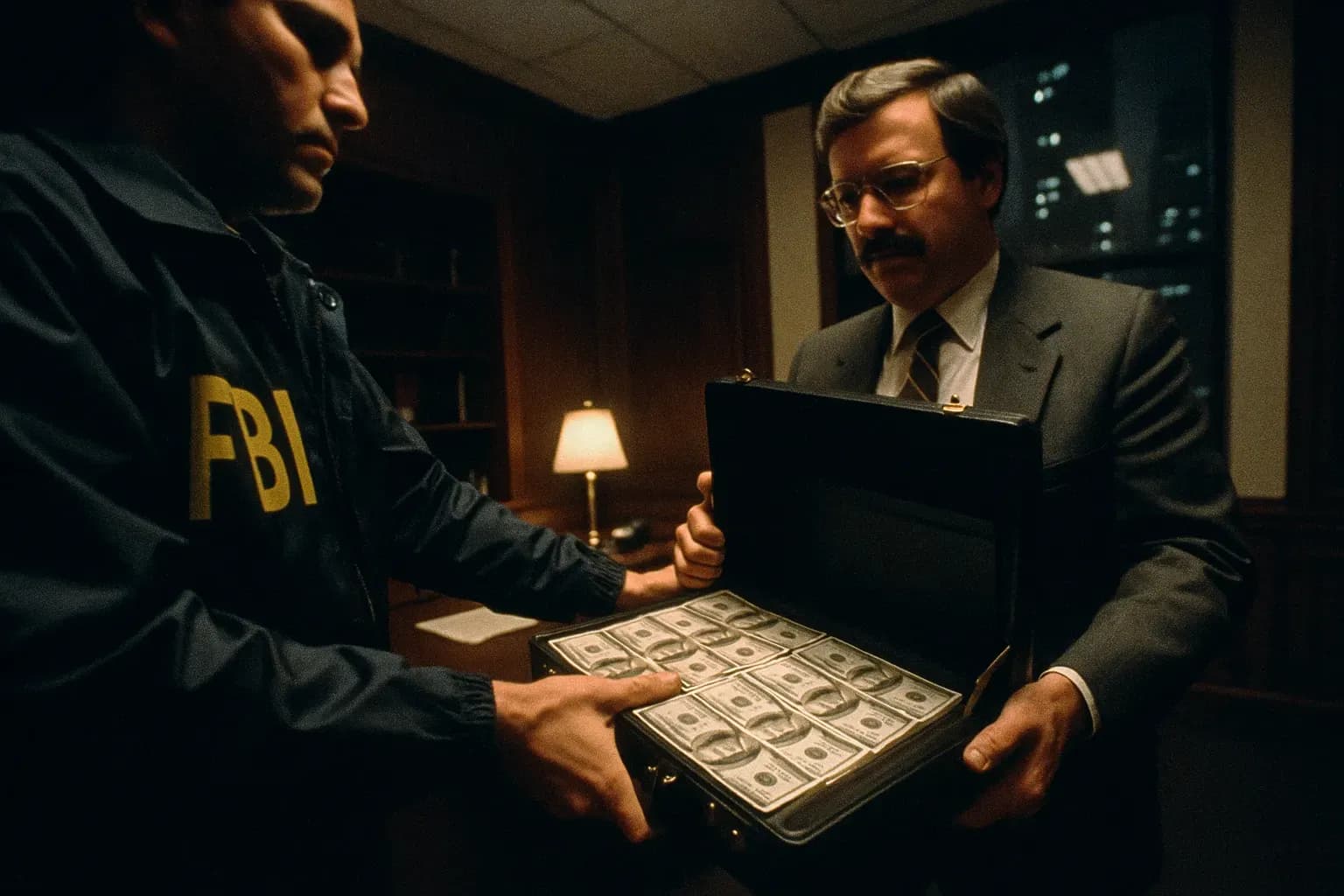
The FBI launched the covert undercover phase in 1980 in cooperation with other agencies. The methods were unusual: agents infiltrated the Cook County system from the inside, including by appearing as lawyers in real court cases and by installing hidden microphones in judges' offices and corridors. Fictitious cases were run through the system to document how bribery actually worked in practice.
This approach gave investigators direct, documented evidence of the exchange of money and favours — not merely witness testimony, but audio recordings and observations from within the corrupt practice itself. The undercover phase continued until 1983, but was cut short when a leak in August of that year forced the FBI to go public earlier than planned.
The operation has since been studied extensively as an example of the FBI's use of long-term undercover methods in combating institutional corruption, and has been described as a landmark in American law enforcement history.
Trial and Sentencing
Following the public disclosure in August 1983, federal prosecutions continued over the ensuing years. In total, 92 people were indicted. The defendants represented a broad cross-section of the Cook County system: 17 judges, 48 lawyers, 8 police officers, 10 deputy sheriffs, 8 court officials, and 1 state representative.
The case resulted in numerous convictions — both through guilty pleas and following jury trials in federal court. Among the specifically named judges convicted were Richard LeFevour and Reginald Holzer, both former judges of the Cook County Circuit Court.
Because the prosecutions took place in the federal court system, the framework for charges and sentencing was different — and often stricter — than under state law. This was a deliberate choice that underscored the case's nature as a threat to the federal legal order.
The Case Today
Operation Greylord is today a closed, historical case. The undercover phase ended with the disclosure in August 1983, and the subsequent federal prosecutions have also concluded.
The case is still studied at American law schools and in courses on judicial ethics, institutional integrity, and investigative methodology. It raises questions that reach beyond Chicago and the 1980s: What happens when the institution entrusted with upholding the law is itself corrupt? And what methods are justified in exposing that kind of systemic failure?
For the American justice system, Operation Greylord marked a turning point in the understanding that judicial corruption is not limited to individual greed but can become embedded in the institutional culture of an entire system — and that exposing it requires extraordinary investigative measures.
Ask about this case
Answers from KrimiNyt's coverage onlyFollow this case
Get an email when a new documentary, podcast or book about Operation Greylord: How the FBI Exposed Corruption in Chicago's Courts appears, or when a verdict is reached.