The Salisbury Poisonings: A Spy Next Door
CNN/Sky Documentaries, 2026 — the Novichok attack on the Skripals and the death of Dawn Sturgess
Quick facts
What Is the Series About?
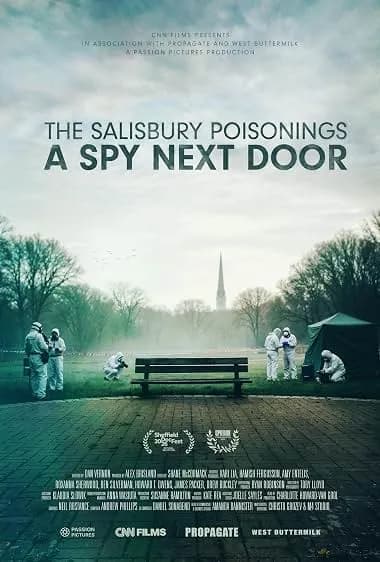
The Salisbury Poisonings: A Spy Next Door is a 2026 feature-length documentary film directed by Dan Vernon that examines one of the most audacious acts of chemical warfare carried out on British soil since World War II. Running 79 minutes, the film revisits the March 2018 Novichok poisoning of former Russian intelligence officer Sergei Skripal and his daughter Yulia in the English city of Salisbury, and traces the devastating ripple effect of that attack — culminating in the death of a wholly innocent British civilian, Dawn Sturgess. The documentary premiered on CNN on July 13, 2026, before becoming available to UK audiences on Sky Documentaries and Now.
The Case
On March 4, 2018, Sergei Skripal — a former colonel in Russia's FSB who had spied for British intelligence — and his visiting daughter Yulia were found unconscious on a public bench in Salisbury city centre. Both had been exposed to Novichok, a class of nerve agents originally developed by the Soviet military. British investigators rapidly established the cause of the collapse, and within days the investigation had grown into an international crisis.
As CNN's coverage of the documentary notes, the attack was widely described as an attempted assassination ordered at the highest levels of Russian state power, targeting Skripal as a traitor who had passed the identities of Russian intelligence assets to MI6. Both Sergei and Yulia Skripal survived, though their recovery was long and gruelling.
The tragedy did not end there. Months later, in late June 2018, a Salisbury man named Charlie Rowley discovered what he believed to be an unopened bottle of Nina Ricci perfume and gave it to his partner, Dawn Sturgess. Sturgess applied what she believed to be perfume to her wrists. The bottle was in fact the vessel used to smuggle Novichok into Britain. She fell gravely ill and died on July 8, 2018 — the only confirmed fatality of the attack, and a woman who had no connection whatsoever to the world of espionage.
British authorities identified two suspects travelling under the names Alexander Petrov and Ruslan Boshirov, later confirmed by open-source investigators at Bellingcat to be officers of the GRU, Russia's military intelligence directorate. The men had entered the UK on Russian passports, visited Salisbury twice in the days before the poisoning, and left Britain hours after the attack. Despite being charged in absentia by UK prosecutors, neither man has faced trial. Russia has refused to extradite them and continues to deny state involvement in the poisonings.
Production
The documentary was directed by Dan Vernon and had its international festival premiere at CPH:DOX, the Copenhagen International Documentary Film Festival, one of Europe's most prestigious platforms for non-fiction filmmaking. Vernon's approach, according to available coverage, centres the human cost of the attack as much as the geopolitical drama — giving prominence to the experiences of frontline emergency responders, the local Salisbury community, and the family of Dawn Sturgess, whose death transformed an assassination attempt into a murder inquiry.
The film draws on the long aftermath of the 2018 attack, including the public inquiry into Sturgess's death that sat in the UK in the years following the poisonings. That inquiry, chaired by a senior judge, examined in forensic detail how the nerve agent entered the country, how it was deployed, and why a civilian came to die as a result. The documentary appears to draw on testimony and material from that process to construct its account.
Reception
Early audience response has been positive. One film catalogue site recorded a score of 7.9 out of 10 from 34 votes at the time of writing, suggesting a strong reaction from viewers who sought the film out. The Guardian's review described the documentary in terms that emphasise its value as both a gripping piece of storytelling and an important public record of an episode that has still not been fully resolved in legal or diplomatic terms.
Critical coverage has highlighted the documentary's ability to balance the spy thriller dimensions of the Skripal attack — the false identities, the nerve agent concealed in a perfume bottle, the GRU tradecraft — with the deeply human story of Dawn Sturgess and the community of Salisbury that found itself at the centre of a Cold War-style operation. The subject matter remains politically sensitive: the UK government's conclusion that the Russian state was responsible for the attack has never been formally contested in a court of law, and relations between London and Moscow remain severely damaged.
No formal IMDb rating has been confirmed for this title at the time of publication.
The Case Today
The legal aftermath of the Salisbury poisonings remains unresolved. The two GRU suspects identified by British authorities are believed to be living in Russia, beyond the reach of UK law. The public inquiry into Dawn Sturgess's death produced findings that placed responsibility squarely on the Russian state, but no criminal trial has taken place for any named individual.
Sergei and Yulia Skripal have been living under new identities in a disclosed but undisclosed location, protected by the British security services. Charlie Rowley, Sturgess's partner who found the poisoned perfume bottle, has continued to speak publicly about his experience and the lack of accountability.
The Salisbury poisonings occupy a unique place in modern British history: the first offensive use of a nerve agent in Europe since World War II, an act of state-sponsored violence that killed a blameless British civilian, and a case that — despite exhaustive investigation — has yet to produce a single criminal conviction. The documentary arrives at a moment when the questions it raises about Russian intelligence operations in the West, the vulnerability of civilian populations to state-sponsored violence, and the limits of international accountability remain as urgent as ever.