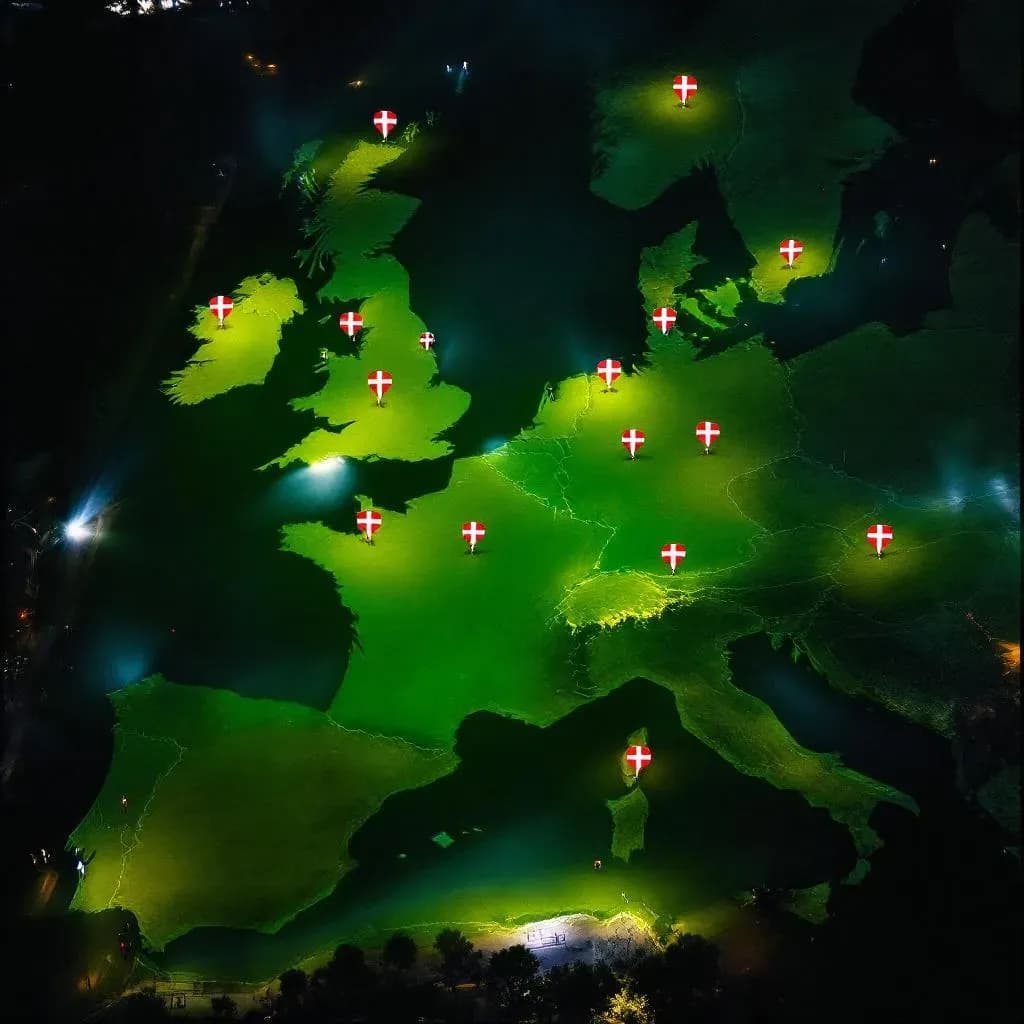
For the first time in Danish football history, more than 400 players hold professional contracts outside their home country. The figure of 405—comprising 323 men and 82 women—represents a watershed moment for a small Nordic nation's place in the global sports economy.
Distributed across 35 countries on five continents, these Danish athletes represent far more than individual career moves. The expansion signals a fundamental shift in how smaller European football nations function within the modern game: as talent pipelines rather than talent reservoirs.
**The Nordic Pipeline**
Norway emerges as the unexpected leader, hosting between 52 and 57 Danish players—a geographic proximity that reflects both cultural ties and practical convenience. Sweden and Germany follow closely with 36 and 35 Danish players respectively, while England ranks fourth with 34. This concentration in nearby European leagues underscores the reality that most Danish players move only as far as necessary to access higher-level competition.
The data highlights a paradox facing Scandinavian football: Denmark has produced world-class talent and maintains a technically proficient domestic league, yet cannot retain its best players. This pattern mirrors challenges seen in Belgium, Portugal, and other nations caught between developing elite players and lacking the financial resources of England's Premier League, Spain's La Liga, or Italy's Serie A.
**Six-Year Acceleration**
The doubling of Danish players abroad in just six years—from approximately 200 to 405—suggests either improved tracking by Danish football authorities or a genuine acceleration in emigration. Either way, the trend reflects globalisation's impact on professional football.
Smaller nations have historically lost players to larger leagues, but the scale and speed of Denmark's exodus reflects new economic realities. Wage inflation in elite leagues, combined with improved scouting networks, means even promising mid-tier Danish players now have viable pathways to better-paying foreign contracts.
**Gender Dynamics**
The inclusion of 82 female players among the 405 marks a significant shift. Women's football's recent professionalization—accelerated by media investment in leagues like England's WSL and Spain's Liga F—has created international opportunities previously unavailable. For Danish women footballers, foreign contracts now represent legitimate career paths, not anomalies.
**The Braithwaite Exception**
Among the 405, one player notably stands apart: Martin Braithwaite, the only Danish footballer with a contract in South America, currently playing for Grêmio in Brazil. Braithwaite's presence in South America, rather than Europe, reflects both his elite status and the global reach of modern football recruitment.
**International Implications**
Denmark's situation mirrors broader European trends. Nations like Scotland, Portugal, and the Czech Republic experience similar brain drains, even as they produce capable players. The concentration of wealth in a handful of leagues—England, Spain, France, Italy, and Germany—creates a gravitational pull that smaller nations cannot resist.
For Danish football authorities, the surge presents both opportunity and challenge. International success brings prestige and media revenue, but a hollowed domestic league may struggle to develop future generations. Other Scandinavian countries, including Norway and Sweden, likely face comparable pressures.
**Future Outlook**
Unless Danish league finances improve dramatically or restrictions on player movement emerge, the 405 figure will likely continue rising. The record represents not a crisis but a recalibration: Denmark remains a football nation, but increasingly functions as an exporter of talent rather than a closed ecosystem.
For international scouts and larger clubs, this trend offers a strategic insight: Danish football remains a reliable source of technically sound, disciplined players willing to embrace new environments—a reputation that will likely drive continued emigration regardless of domestic league improvements.