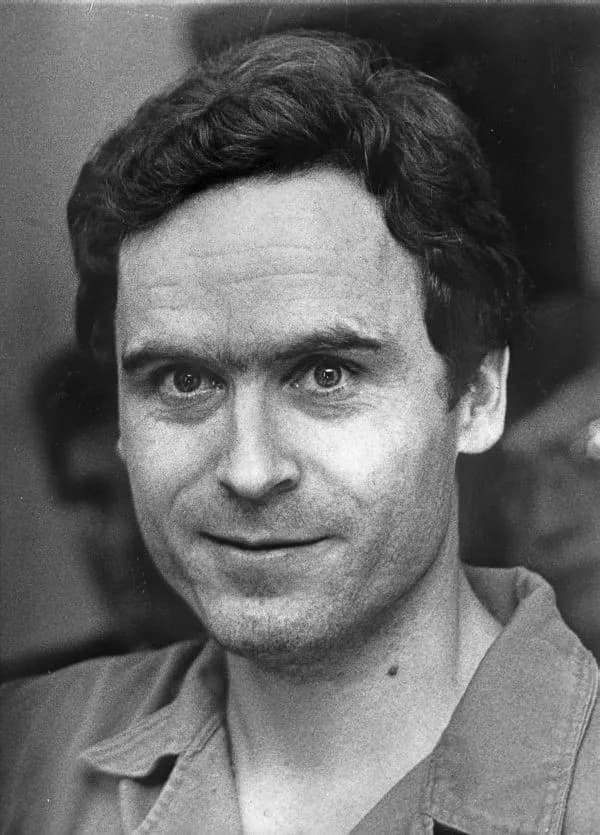
Theodore Robert Bundy—born November 24, 1946—became one of America's most infamous serial killers, operating across six states over a four-year period that would terrify the nation and fundamentally change how law enforcement approached violent crime investigations.
Bundy's known murders began in February 1974 in Washington state, though his predatory behavior surfaced earlier. In January 1974, he broke into the apartment of Karen Sparks in Seattle, bludgeoning and sexually assaulting her. Sparks survived, but she was far from his only victim.
What distinguished Bundy from other killers was his calculated method and psychological manipulation. He didn't fit the stereotype of a dangerous criminal. Handsome, articulate, and intelligent, Bundy used his appearance and charm as a weapon. He posed as a police officer or authority figure to gain access to victims. On November 8, 1974, in Utah, he attempted to kidnap 18-year-old Carol DaRonch by posing as law enforcement—she managed to escape. That same day, 17-year-old Debra Kent vanished, likely another victim.
Bundy's method was deliberate: kidnapping, rape, and murder. He targeted young women across Washington, Oregon, Colorado, Utah, and Idaho before turning his attention to Florida in 1978. Among his confirmed victims were Kimberley Leach and Lynette Culver, both just 12 years old, highlighting the predatory nature of his crimes.
Despite his careful planning, law enforcement eventually closed in. In 1975, Bundy was arrested in Utah for aggravated kidnapping and attempted criminal assault. The arrest should have ended his killing spree, but Bundy was not finished. In 1977, he escaped from a courthouse library window—a stunning security breach that demonstrated both his cunning and the vulnerabilities of the justice system at the time.
Free again, Bundy fled to Colorado but was recaptured and jailed. In 1978, he orchestrated another escape from a Colorado jail, this time fleeing to Florida where his most vicious crimes would unfold. In Florida, he committed multiple murders, including a brutal attack on the Chi Omega sorority house. On February 15, 1978, after a routine traffic stop in Pensacola, police officer David Lee apprehended him.
Bundy's trial came in 1979. On July 24, he was convicted of first-degree murder in the deaths of Margaret Bowman and Lisa Levy, along with attempted murder of three other victims. He received the death penalty.
For a decade, Bundy remained on death row, becoming a macabre celebrity. He confessed to over 30 murders, though verified cases number at least 20 to 30. His case became a landmark moment in criminal psychology and forensic investigation, as law enforcement worked to understand how someone so outwardly normal could commit such heinous acts.
On January 24, 1989, Bundy was executed by electrocution in Florida State Prison using the electric chair known as "Old Sparky." He was pronounced dead at 7:16 a.m. His execution drew massive crowds and marked the end of one of America's most disturbing criminal chapters.
Decades later, advances in DNA technology have continued to verify victims linked to Bundy's crimes. In 2026, DNA confirmation connected him definitively to victim Aime, demonstrating how scientific progress can illuminate even historical cases.
Ted Bundy's legacy remains a cautionary tale about the dangers of predators who operate beneath a facade of normalcy, and the importance of rigorous law enforcement protocols in catching serial offenders.
**Sources:**
https://en.wikipedia.org/wiki/Ted_Bundy
https://www.biography.com/crime/ted-bundy-timeline-murders
https://www.crimeandinvestigation.co.uk/articles/most-evil-and-heinous-acts-ted-bundy