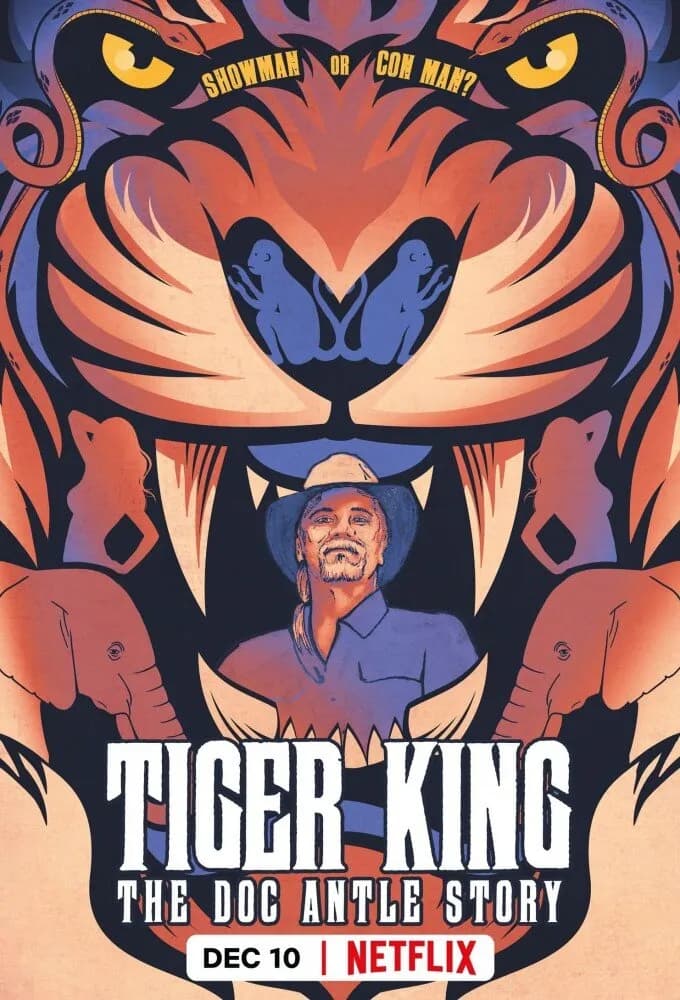
Tiger King: The Doc Antle Story
Netflix, 2021 — The exotic-animal empire and criminal allegations surrounding Bhagavan 'Doc' Antle
Quick facts
What Is the Series About?
Tiger King: The Doc Antle Story is a Netflix true-crime docuseries that focuses squarely on Bhagavan "Doc" Antle, the founder and operator of Myrtle Beach Safari in South Carolina, and the sprawling criminal allegations that have shadowed his exotic-animal entertainment empire for years. Released in 2021 as a three-episode spin-off within the Tiger King franchise, the series drills down into Antle's world in a way that the original Tiger King series only briefly touched upon — examining allegations of wildlife exploitation, manipulation of workers and followers, and the systemic abuse of endangered animals kept at his facility.
Unlike a conventional true-crime documentary built around a single homicide, this installment centers on institutional wrongdoing: the alleged exploitation of big cats and other protected species for profit, the controversial living and working conditions at Myrtle Beach Safari, and the growing legal net that investigators were drawing around Antle and his business. The series operates at the intersection of animal welfare advocacy, conservation law, and the lurid celebrity culture that surrounded the exotic-animal trade in the United States.
The Case
At the center of the documentary is Bhagavan "Doc" Antle, a long-time figure in the American exotic-animal entertainment industry and a self-styled guru who built Myrtle Beach Safari into one of the most prominent — and most controversial — wildlife parks of its kind. Antle had already appeared in the original Tiger King series as an influential and deeply divisive character, portrayed as wielding enormous influence over the people around him and over the public image of the big-cat trade.
The criminal case that the series anticipates and contextualizes is not a murder case. Instead, the core allegations involve conspiracy to violate the Endangered Species Act, wildlife trafficking, animal cruelty, and money laundering. The "victims" in this case are primarily the animals themselves — big cats and other endangered or protected species allegedly kept in harmful conditions and used as commercial props for profit.
The most newsworthy criminal development came after the series aired: on June 9, 2023, Antle was arrested in South Carolina on charges that included money laundering and animal cruelty. South Carolina law-enforcement officials and wildlife investigators had built a case around his handling of animals and the financial operations tied to his park. Prosecutors alleged unlawful conduct directly connected to those animal operations — a culmination of years of state and federal scrutiny.
Previously, federal investigators had also examined the broader Tiger King network for violations of the Endangered Species Act and wildlife-trafficking statutes, though Antle had for years avoided the kind of decisive criminal outcome that befell his Tiger King co-star Joseph "Joe Exotic" Maldonado-Passage, who was convicted in 2019 on federal charges including a murder-for-hire plot.
As of the most recent widely reported updates available, Antle had not received a final sentence on the South Carolina charges. The case remains procedurally active, and current court records should be consulted for the latest disposition, hearing dates, and plea status.
Production
The series sits within the Tiger King franchise developed and associated with filmmaker Eric Goode and producer Rebecca Chaiklin, the duo behind the original 2020 Tiger King: Murder, Mayhem and Madness, which became one of Netflix's most-watched documentary events of the pandemic era. The Doc Antle Story follows the same sensationalist-yet-investigative template: hidden-camera-style footage, interviews with former employees and associates, and archival material documenting life inside Myrtle Beach Safari.
The three-episode format allows the series to move beyond surface-level character portraiture into more detailed examination of how Antle allegedly operated: controlling the people around him through a combination of charisma, financial dependency, and isolation, while simultaneously managing a public image as a conservationist and wildlife educator. Former staff members and individuals who claim to have lived within Antle's inner circle provide testimony about conditions at the facility and about Antle's alleged behavior toward both animals and people.
The production arrived at a moment when public and legislative appetite for exotic-animal reform was near an all-time high, with the federal Big Cat Public Safety Act — which would restrict private ownership and public contact with big cats — advancing through Congress. The timing gave the series a policy urgency beyond mere entertainment.
Reception
Reception to Tiger King: The Doc Antle Story was shaped almost entirely by the gravitational pull of the original Tiger King phenomenon. Audiences who had binged the first series arrived curious and primed for more outrage, and the spin-off delivered the franchise's familiar cocktail of jaw-dropping revelations, ethically murky characters, and animal welfare horror.
Critically, the series received a mixed-to-moderate response. Supporters praised it for sharpening the focus on Antle specifically — a character many felt the original series had treated too lightly — and for centering the suffering of animals rather than the interpersonal drama of their human keepers. Critics, however, argued that the franchise had by this point developed a formula: maximum sensationalism, minimum structural accountability. Some reviewers questioned whether the documentary format was being used to genuinely advance justice for exploited animals, or whether Netflix was simply mining the Tiger King brand for continued streaming revenue.
Viewer reactions on social platforms reflected similar tensions: strong engagement and widespread sharing driven by Antle's unsettling charisma and the disturbing footage of animal conditions, alongside genuine debate about whether repeated documentary exposure was translating into meaningful legal or legislative consequences.
An IMDb rating for this specific installment was not confirmed at publication time and should be verified directly on the IMDb title page.
The Case Today
The story that Tiger King: The Doc Antle Story began telling in 2021 continued to develop in the courts long after the cameras stopped rolling. Antle's June 2023 arrest on money laundering and animal cruelty charges in South Carolina marked a significant escalation, confirming that investigators had accumulated sufficient evidence to pursue him directly. The charges represent the most serious formal legal action taken against Antle in a career that had attracted controversy for decades.
The case remains unresolved at the time of this writing. No final conviction, plea agreement, or sentence has been widely reported for the South Carolina proceedings. For readers seeking the current procedural status — including any indictment updates, hearing schedules, or plea developments — South Carolina court records and reporting from wire services and local South Carolina outlets represent the most reliable sources.
Beyond the courtroom, the broader landscape that made Antle's operation possible has shifted. The Big Cat Public Safety Act was signed into federal law in December 2022, significantly restricting private ownership of big cats and prohibiting public contact with cubs — directly targeting the kind of pay-to-play cub-petting that had long been central to Myrtle Beach Safari's business model. Whether the law arrives too late to protect the animals already in Antle's care remains an open and urgent question.
For the animals documented in the series, the outcome of the human legal proceedings may matter less than the regulatory environment that surrounds them — and whether authorities will use new legal tools to remove them from conditions that investigators allege were harmful from the start.