The Slow Hustle
HBO Max, 2021 — The unsolved death of Baltimore detective Sean Suiter
Quick facts
What Is the Series About?
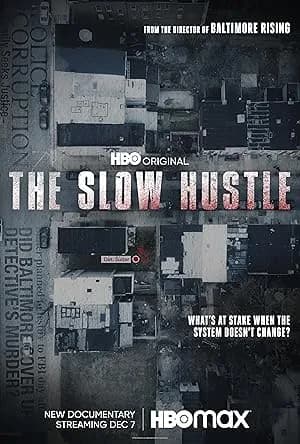
The Slow Hustle is a 2021 HBO Max documentary directed by actress and activist Sonja Sohn — best known for her role as Detective Kima Greggs in the landmark HBO series The Wire — that investigates the death of Baltimore homicide detective Sean Suiter. Suiter was shot in the head on November 15, 2017, in the Harlem Park neighborhood of Baltimore, dying the following day. The timing was explosive: he had been scheduled to testify before a federal grand jury on November 16, 2017, in connection with the sprawling corruption case against the Baltimore Police Department's own Gun Trace Task Force. The documentary asks the question that has haunted Baltimore ever since: was Suiter murdered to silence him, or did he take his own life?
Sohn, who spent years in Baltimore during the filming of The Wire and developed deep ties to the city and its communities, brings both an insider's access and a genuine emotional investment to the material. The result is a film that refuses easy answers, sitting uncomfortably at the intersection of police corruption, institutional distrust, race, and grief.
The Case
Sean Suiter was a 18-year veteran of the Baltimore Police Department, a homicide detective with a reputation as a dedicated investigator. On the afternoon of November 15, 2017, Suiter and his partner were canvassing the Harlem Park neighborhood in West Baltimore as part of a homicide investigation when Suiter was shot in the head with his own service weapon. His partner reported hearing a struggle and a gunshot. Suiter was transported to hospital in critical condition and pronounced dead the following day.
What made the case immediately extraordinary was its timing. Suiter had been subpoenaed to testify before a federal grand jury investigating the Gun Trace Task Force (GTTF), an elite Baltimore police unit that had descended into brazen criminality. GTTF officers were eventually convicted of robbing civilians at gunpoint, planting evidence, dealing drugs, and submitting fraudulent overtime claims — a scandal that shook the city's already fractured relationship with its police department to its foundations.
Whether Suiter was connected to the GTTF's crimes, or whether he was a witness against them, was never definitively established publicly. Baltimore PD's response to his shooting was itself controversial: authorities established an unprecedented security perimeter around Harlem Park, blockading the neighborhood and restricting the movement of residents for several days — a move that many community members and civil liberties advocates condemned as a collective punishment of a predominantly Black neighborhood.
The investigation into Suiter's death stalled. No suspect was ever charged. In 2019, an independent review panel commissioned by Baltimore City issued a report concluding that the evidence pointed most strongly toward suicide — a conclusion that Suiter's widow, Nicole Suiter, and many of his colleagues rejected with fury. The family maintained that Sean Suiter was not suicidal and that the ruling was a convenient way to close an embarrassing case.
The suicide ruling also carried a brutal practical consequence: it initially threatened to strip Suiter's family of survivor benefits, since line-of-duty death benefits are typically not paid in cases of suicide. The family fought the determination, and the case around his benefits became a secondary legal battle layered on top of the unresolved question of what actually happened in Harlem Park.
Production
Director Sonja Sohn spent years researching and filming The Slow Hustle. Her connection to Baltimore gave her access that an outside filmmaker might not have secured — she was able to sit with Nicole Suiter and the couple's children, with fellow detectives who worked alongside Sean, and with community members in Harlem Park who witnessed the police lockdown firsthand.
The documentary draws on a wide range of sources: interviews with Baltimore police veterans, journalists who covered the GTTF scandal, community activists, and legal experts who analyzed the independent panel's findings. Sohn also incorporates archival news footage and records from the GTTF prosecutions to situate Suiter's death within the full scope of the corruption crisis.
The film does not pretend to solve the case. Instead, it methodically dismantles the certainty with which the independent panel delivered its suicide ruling, presenting counter-evidence and witness accounts while acknowledging that the truth may never be fully recoverable. Sohn has spoken in interviews about the difficulty of making a film that honors a family's grief without exploiting it, and that tension is visible throughout the documentary's approach to Nicole Suiter and her children.
The choice of Sonja Sohn as director adds a layer of meta-narrative complexity: a woman who spent years playing a Baltimore police detective on a fictional series that was itself a celebrated examination of systemic dysfunction in American cities now investigates a real case that reads like an extension of that fiction into reality.
Reception
The Slow Hustle was well received by critics upon its HBO Max debut in late 2021. Reviewers praised Sohn's restrained but emotionally engaged direction, and many noted that the film succeeds as both a personal portrait of a family living in the shadow of unresolved loss and as a rigorous piece of investigative journalism. Critics highlighted the documentary's willingness to hold space for ambiguity in a genre that often gravitates toward tidy resolutions.
Several reviews drew explicit comparisons to David Simon's The Wire, noting that the real-world corruption exposed by the GTTF scandal validated the show's bleak portrait of Baltimore policing — and that Sohn's presence as director gave the film an unusual resonance. The documentary was discussed in the context of broader conversations about police accountability and the Black Lives Matter movement that had intensified following the murder of George Floyd in 2020.
The film's IMDb rating was not widely circulated in major coverage, and detailed aggregated scores were not confirmed at the time of this writing.
The Case Today
As of the time of the documentary's release and in the period following, the death of Sean Suiter officially remained classified as a suicide by the independent review panel, a determination that has never been universally accepted. No criminal charges were ever filed in connection with his death. The Baltimore Police Department has continued to grapple with the aftermath of the Gun Trace Task Force scandal, with convictions of the GTTF officers triggering hundreds of case reviews and contributing to a severe erosion of public trust in the department.
Nicole Suiter has continued to advocate publicly for a re-examination of her husband's death. The case remains one of the most discussed and contested unsolved questions in Baltimore's recent history — a city that has seen extraordinary levels of violent crime and police misconduct intertwined in ways that make the line between victim and perpetrator, between corruption and cover-up, deeply difficult to draw.
The Slow Hustle stands as a document not only of one family's grief and one detective's ambiguous end, but of a city's ongoing reckoning with what it means when the institutions charged with solving crimes are themselves criminal.