The Scheme
HBO Max, 2020 — the college basketball recruitment bribery scandal
Quick facts
What is the series about?
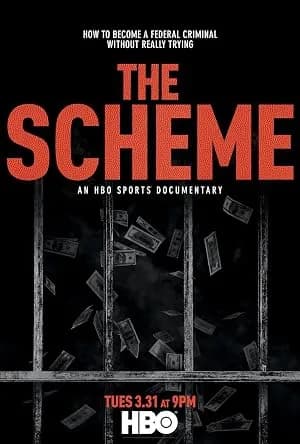
The Scheme is an HBO documentary directed by Pat Kondelis that examines one of the most explosive corruption scandals in the history of American college sports. Released on March 31, 2020, the film centers on Christian Dawkins, a young sports agent who became the linchpin of an FBI undercover investigation into bribery, fraud, and the illegal funneling of money to college basketball recruits and their families. The documentary is remarkable for the uncommon level of access Kondelis secured: Dawkins himself sits for extensive on-camera interviews, presenting his version of events with candor and defiance.
The Case
In September 2017, the FBI and the U.S. Attorney's Office for the Southern District of New York announced arrests that stunned the college sports world. Assistant coaches at powerhouse programs — including Auburn, Arizona, Oklahoma State, and USC — were taken into custody alongside an Adidas executive and several sports agents. The charges: wire fraud, bribery, and conspiracy. The government alleged that coaches, agents, and apparel company representatives had been secretly paying recruits and their families to steer top high school talent toward specific universities and, ultimately, toward particular agents when those players turned professional.
At the center of the web was Christian Dawkins, then in his mid-twenties, already a well-connected figure in the basketball recruiting ecosystem. Dawkins had worked under prominent NBA agent Andy Miller and cultivated relationships with coaches, players, and families across the country. The FBI used a confidential informant — a man named Marty Blazer, a financial advisor who had himself committed fraud and was cooperating to reduce his own exposure — to set up meetings with Dawkins and others. An undercover FBI agent posing as a would-be investor in a sports management company met repeatedly with Dawkins, recording conversations in which payments to recruits and their families were discussed openly.
Dawkins was tried twice in federal court in New York. His first trial, in October 2018, resulted in a conviction alongside former Adidas consultant Merl Code. A second trial in 2019, focused on the university coaches, also ended in Dawkins's conviction on wire fraud conspiracy charges. He was ultimately sentenced to approximately six months in prison. Several assistant coaches were also convicted, and the scandal forced the NCAA to confront uncomfortable questions about the hypocrisy embedded in the so-called amateur model — a system worth billions of dollars to universities and media partners, yet one that prohibited the athletes generating that revenue from receiving any meaningful compensation.
Production
Director Pat Kondelis had previously made Disgraced, a documentary about the University of Louisville basketball scandal, which gave him both credibility and contacts in the college basketball world. His ability to convince Dawkins to participate extensively in The Scheme is the documentary's defining editorial achievement. Dawkins does not hide behind lawyers or speak in careful platitudes. He talks freely about how money moved through the system, names names, and advances the argument that the entire apparatus of college basketball was already corrupt — and that the FBI, working through a compromised informant, essentially manufactured crimes to make examples of people who were simply doing openly what everyone else was doing quietly.
The film also includes commentary from legal analysts and basketball insiders, and it weaves in the secretly recorded audio and video that formed the backbone of the government's case. This gives viewers direct access to the evidence while allowing Dawkins to contextualize and challenge its meaning.
Kondelis frames the story not merely as a tale of personal misconduct but as a systemic indictment: the NCAA's longstanding prohibition on paying players, he suggests, created the black market conditions that made schemes like Dawkins's not just possible but perhaps inevitable. This framing proved provocative, arriving at a moment when the debate over college athlete compensation was already reaching a tipping point.
Reception
Critical reception to The Scheme was broadly positive, with reviewers praising the documentary's propulsive energy and the sheer audacity of Dawkins as an interview subject. Many critics noted that the film succeeds precisely because it refuses to be a simple morality tale. Dawkins is charismatic, self-aware, and occasionally self-serving, and Kondelis does not shy away from letting those contradictions sit on screen.
Some commentators, however, raised concerns that the documentary granted Dawkins an uncritical platform. The recruits and their families — whose amateur eligibility was jeopardized by the payments — receive relatively little attention, and the film's sympathies tilt noticeably toward Dawkins's entrapment narrative rather than toward a full accounting of all perspectives involved. Sports journalists who had covered the story closely noted that the documentary occasionally simplified a genuinely complex legal and ethical landscape.
Nevertheless, the timing of the release — during the early weeks of pandemic lockdowns in the United States — meant the documentary reached a large, captive audience, and it generated substantial conversation on social media and in sports media circles about the fundamental fairness of the NCAA's model.
The Case Today
The The Scheme scandal did not end with the convictions. Its aftershocks have continued to reshape college sports in meaningful ways. The legal and public pressure generated by the FBI investigation — and the broader cultural conversation it amplified — contributed to the environment in which the NCAA ultimately relented on athlete compensation. In 2021, the NCAA adopted interim Name, Image, and Likeness (NIL) rules allowing college athletes to profit from their own brands, a seismic shift that effectively dismantled one of the central justifications for the old system that Dawkins had long argued was corrupt.
Several of the convicted coaches have since returned to coaching in various capacities, reflecting the complex and sometimes forgiving nature of the sports industry toward those who have served their time. Dawkins himself, following his release, has remained a vocal commentator on the state of college basketball and player representation, continuing to insist that his prosecution was selective and politically motivated.
For viewers returning to The Scheme today, the documentary functions as a time capsule of a specific inflection point — a moment when the contradictions of the college sports economy could no longer be sustained by the old rules, and when the question of who gets to profit from young athletes' talent was finally being forced into the open.