The Last Hours of Mario Biondo
Netflix, 2023 — the disputed death of Italian cameraman Mario Biondo in Madrid
Quick facts
What Is the Series About?
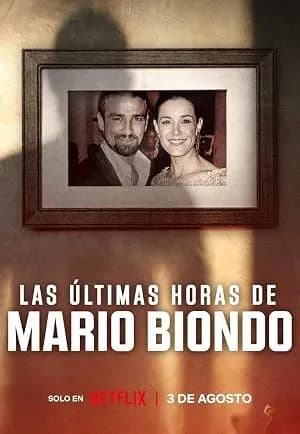
The Last Hours of Mario Biondo is a three-episode Netflix documentary series that examines one of the most bitterly contested deaths in recent Spanish-Italian true-crime history: the 2013 death of Italian cameraman Mario Biondo in Madrid. Directed by María Pulido and released on 3 August 2023, the series revisits a case that unfolded over nearly a decade, involving 16 Spanish judges, 5 Italian prosecutors, 2 exhumations, 3 autopsies, and — despite all of it — zero convictions. The documentary occupies the space between an official ruling of suicide and a family's unyielding insistence that their son was murdered, inviting viewers to weigh evidence that courts in two countries could not conclusively resolve.
The Case
On the morning of 30 May 2013, Mario Biondo — an Italian cameraman from Sicily — was found dead in the Madrid apartment he shared with his wife, renowned Spanish television presenter Raquel Sánchez Silva. He was discovered hanging, and Spanish authorities swiftly ruled the death a suicide, citing an absence of criminal evidence. The case was officially closed.
Biondo's family in Sicily refused to accept that conclusion from the outset. His parents and siblings launched a prolonged campaign to have the case reopened and investigated as a potential homicide, arguing that the physical evidence at the scene was inconsistent with a self-inflicted death and pointed instead to a staged crime scene. Their persistence drove years of parallel legal proceedings in both Spain and Italy, making the Biondo case a rare example of a death being simultaneously litigated across two separate national jurisdictions.
The scale of the legal effort is staggering by any measure. According to reporting on the documentary, the case accumulated 16 Spanish judges, 5 Italian prosecutors, 2 separate exhumations of Biondo's body, and 3 independent autopsies — each producing findings that advocates on both sides of the debate used to support their positions. The divergence in expert conclusions became one of the case's defining features and one of the documentary's central narrative threads.
In 2022, nearly nine years after Biondo's death, Italian judge Nicola Aiello issued a ruling concluding that Mario Biondo had indeed been murdered and that the scene had been deliberately staged to look like a suicide. This was a significant moment for the family, but it did not result in criminal charges against any named individual. As coverage of the series makes clear, no person has ever been legally convicted in connection with Biondo's death, and no universally accepted final criminal judgment identifying a perpetrator exists. The case officially remains unresolved.
Raquel Sánchez Silva, who was never charged with any crime in connection with her husband's death, has remained a prominent figure in Spanish television throughout the years the case remained in the public eye. The documentary revisits her role as Biondo's widow and the way in which the family's public campaign inevitably cast scrutiny on those closest to him — without producing actionable evidence against anyone.
Production
The series was directed by María Pulido and produced for Netflix as a three-episode limited documentary. It was released on 3 August 2023 and is rated TV-MA on the platform. The IMDb listing classifies it as a TV Mini Series with title ID tt28457132.
Pulido's approach centres the Biondo family's decade-long search for justice, using the accumulation of legal proceedings, forensic contradictions, and media coverage as structural scaffolding for the narrative. The series draws on interviews, archival footage, and documentation of the Italian and Spanish legal processes to reconstruct both the original events and the protracted aftermath. The decision to frame the story primarily through the family's perspective gives the series an emotionally driven quality that some reviewers found compelling and others found limiting.
The documentary benefits from the inherent dramatic architecture of the case itself: two countries, two legal systems, multiple conflicting forensic opinions, and a conclusion — or lack thereof — that satisfies neither side of the debate. María Pulido leans into that ambiguity rather than resolving it, which is both the series' strength as an atmospheric piece and the source of its most substantive criticisms.
Reception
Critical reception to The Last Hours of Mario Biondo has been broadly respectful but mixed. Reviewers have generally described it as a conventional but emotionally heavy true-crime docuseries that prioritises the human cost of an unresolved case over forensic rigour. The series has been praised for the access it appears to have obtained to family members and for the coherent way it organises an exceptionally complex legal timeline spanning two countries and nearly a decade.
The most consistent criticism levelled at the documentary is that it leans into unresolved speculation without always being transparent about the limits of the evidence it presents. Some reviewers have noted that the series' framing — built around the family's conviction that Mario was murdered — can blur the line between documented fact and inference, particularly when presenting expert forensic testimony that was itself contested by other equally credentialed experts in court. This is a tension that runs through many true-crime documentaries built around unresolved cases, and Pulido's series is not unique in navigating it imperfectly.
Viewer reaction has been intense, particularly in Spain and Italy, where the case carried years of tabloid and mainstream media coverage before the Netflix series aired. Public debate about whether Biondo died by suicide or was killed has continued in online forums and social media since the documentary's release, suggesting the series succeeded at least in its goal of returning the case to wider public consciousness.
The Case Today
As of the series' release in August 2023, the legal status of the Mario Biondo case remained unresolved. Despite Judge Nicola Aiello's 2022 Italian ruling that Biondo was murdered and the scene was staged, no criminal prosecution of a named suspect followed, and no conviction has been recorded in either Spain or Italy. The Spanish authorities' original suicide ruling has never been formally overturned by a Spanish court.
The Biondo family has continued to seek justice through available legal channels, but the structural reality — two jurisdictions, contradictory forensic records, and the passage of more than a decade — makes a definitive legal resolution increasingly difficult. The Netflix documentary has ensured that the case remains in the public record and in active discussion, but it has not, as of publication, produced new legal developments. The question of what truly happened to Mario Biondo in Madrid on 30 May 2013 remains, officially, unanswered.