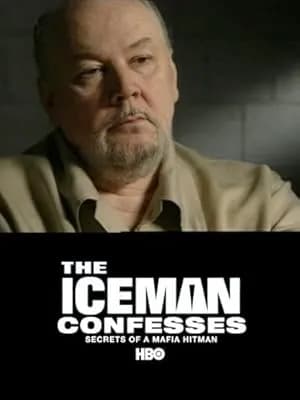
The Iceman Confesses: Secrets of a Mafia Hitman
HBO Max, 2001 — Richard Kuklinski's on-camera confessions as a Gambino family contract killer
Quick facts
What Is the Series About?
*The Iceman Confesses: Secrets of a Mafia Hitman* is a two-part HBO documentary directed by Arthur Ginsberg that premiered on Sunday night, May 20, 2001. The film places convicted contract killer Richard Leonard Kuklinski directly in front of the camera, allowing him to describe — in his own words — murders he claims to have carried out on behalf of the Gambino crime family of New York. Among the most explosive admissions in the broadcast is Kuklinski's on-camera confession to the 1980 killing of New York City Police Detective Peter Calabrese, a case that had haunted investigators for more than two decades. The documentary is also known under the alternate title The Iceman: Confessions of a Mafia Hitman and carries an IMDb rating of 7.5/10.
The 2001 production is part of a longer cycle of HBO documentaries built around Kuklinski's willingness to speak from prison about his alleged crimes. Rather than reconstructing a single case through archival footage or courtroom drama, the film centers on Kuklinski's direct testimony — a format that makes it both compulsively watchable and, for critics, methodologically complicated.
The Case
Richard Leonard Kuklinski was a New Jersey-based contract killer whose criminal career unfolded in the shadow of the Gambino crime family, one of the most powerful organized-crime organizations in the United States. By the time the 2001 documentary aired, he was already serving four life terms for murders to which he had previously been convicted or pleaded guilty.
In the HBO interview at the heart of the film, Kuklinski admitted to two additional killings: the 1980 murder of NYPD Detective Peter Calabrese and the killing of Manhattan nightclub owner Bruno Lattini. The Tampa Bay Times reported at the time that Kuklinski also claimed, more broadly, to have killed approximately 100 people for the Gambino family over the course of his career — a figure that investigators and journalists have long regarded with significant skepticism, as the vast majority of these alleged killings were never independently corroborated.
The Calabrese murder is particularly significant within the documentary because killing a law enforcement officer carries enormous legal and moral weight, and because Kuklinski's admission came decades after the detective's death, reopening questions about cold cases tied to organized crime in the New York metro area. The killing of Bruno Lattini, a Manhattan nightclub owner, is presented alongside Calabrese's case as part of the pattern of contract violence Kuklinski claimed to have carried out for organized crime clients.
Kuklinski's criminal background extended well beyond these two killings. He was described by prosecutors and investigators as a professional hitman who used a variety of methods — including, according to his own accounts, cyanide poisoning, firearms, and freezing victims' bodies to obscure time of death, a habit that earned him his nickname, "The Iceman." His willingness to describe these methods on camera, in clinical and sometimes boastful detail, made him a uniquely disturbing figure in American true crime.
Production
The documentary was directed by Arthur Ginsberg, who had prior experience with the Kuklinski subject matter through HBO's earlier documentary work in the series. The 2001 installment sits within HBO's America Undercover strand, a documentary umbrella that gave filmmakers access to subjects and stories considered too raw or controversial for mainstream broadcast television.
The film's runtime is listed at approximately 42 minutes per part on streaming platforms including Apple TV and Prime Video. Its two-part structure allowed Ginsberg to move between Kuklinski's confessional monologues and contextual material about the Gambino family's operations and the New York/New Jersey organized-crime landscape that formed the backdrop of Kuklinski's career.
Access to Kuklinski while he was incarcerated was a significant production achievement. By 2001, Kuklinski had become accustomed to speaking with journalists and documentarians, but his willingness to admit to specific, previously unresolved murders on the record gave the 2001 film a news-value dimension that distinguished it from purely retrospective documentary work.
Reception
The broadcast generated immediate media attention. Coverage in the Tampa Bay Times emphasized the sensational nature of a convicted killer admitting, live on HBO, to the murder of a police detective. The film was framed in press coverage as both a crime documentary and a kind of extended psychological portrait of a man who appeared to feel little remorse for decades of violence.
On IMDb, the film holds a rating of 7.5 out of 10, reflecting sustained viewer interest more than two decades after its premiere. The documentary has been described by retrospective observers, including a 2025 RealityBlurred piece, as part of an "unjustly forgotten" true crime cycle that deserves renewed attention.
A persistent controversy surrounding all Kuklinski-related media — including this documentary — is the question of how much of his self-reported body count and methodology can be trusted. Investigators involved in the original cases have noted that Kuklinski was a skilled self-mythologizer, and that some of his claims appear designed to amplify his own legend rather than reflect verifiable fact. The documentary does not fully resolve this tension, presenting Kuklinski's testimony largely on its own terms while gesturing at the broader unresolved questions his admissions raise.
Availability has also become a minor story in itself. The HBO Max listing for the title carries a "not available in your country" notice in some regions, and some installments of the Kuklinski documentary cycle have migrated to YouTube, creating a fragmented viewing experience for audiences seeking the complete series.
The Case Today
Richard Kuklinski died in prison in March 2006, taking with him whatever additional detail he might have provided about the full scope of his alleged crimes. His death did not close the investigative questions his confessions opened — cold-case detectives have continued, over the years, to examine whether specific unsolved homicides in the New York and New Jersey area might be attributable to Kuklinski based on his recorded statements.
The murders of Detective Peter Calabrese and nightclub owner Bruno Lattini remain among the most documented of Kuklinski's admitted killings, given their on-camera confessional context, but the broader claim of approximately 100 contract killings has never been fully substantiated by independent evidence. The documentary cycle, of which the 2001 film is a central part, stands as the primary public record of Kuklinski's own account of his career — a deeply unreliable narrator speaking from a position of incarceration with nothing immediately left to lose and, perhaps, a legacy still to construct.