Satan Wants You
DRTV / CBC Gem, 2023 — The memoir that ignited the global Satanic Panic
Quick facts
What is the series about?
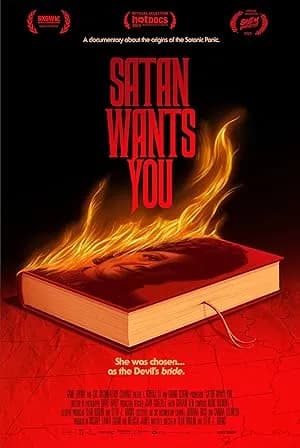
Satan Wants You is a 2023 feature documentary directed by Steve J. Adams and Sean Horlor that investigates the real-world origins of the Satanic Panic — the wave of moral hysteria that swept North America and much of the Western world from the early 1980s through the 1990s, producing false accusations, destroyed lives, and a string of wrongful convictions. The film's central argument, backed by archival footage, expert testimony, and contemporary interviews, is that a single book — Michelle Remembers, published in 1980 — functioned as Patient Zero for an epidemic of manufactured fear. The documentary premiered to strong critical applause at SXSW 2023 and is now available on multiple streaming platforms including CBC Gem, Apple TV, Tubi, and Kanopy.
The Case
The story at the heart of Satan Wants You is not a conventional murder case with a prosecuted killer and a sentenced perpetrator. It is something simultaneously stranger and more consequential: the making of a memoir that many researchers, journalists, and the documentary's own filmmakers regard as a work of fiction that was mistaken — or weaponised — as fact.
Michelle Smith and Lawrence Pazder
In the late 1970s, a young woman named Michelle Smith was undergoing psychiatric treatment with Victoria, British Columbia–based psychiatrist Dr. Lawrence Pazder. Over the course of hundreds of hours of sessions, Smith began producing recovered memories — surfaced through therapy — of alleged childhood abduction, captivity, and ritual abuse at the hands of a Satanic cult operating in Victoria, B.C. Pazder, rather than treating these recovered memories with clinical scepticism, became a co-author of the account. The resulting book, Michelle Remembers (1980), was marketed as a true story and quickly became a sensation.
The memoir described scenes of extreme ritualistic violence, occult ceremonies, and supernatural visitations — including, according to the book's most sensational passages, an appearance by the Devil himself. It was precisely the kind of lurid, authoritative-sounding material that was primed to detonate in a cultural climate already anxious about secularism, changing family structures, and the perceived infiltration of children's spaces by malign outside forces.
As CBC News reported, Adams and Horlor were struck by how little public attention had been paid to the Canadian origins of a panic that most people associated with American day-care trials. The filmmakers conducted extensive research and interviews to reconstruct both the making of the book and its catastrophic downstream effects.
The Panic and Its Victims
The documentary does not confine itself to Smith and Pazder. Its broader canvas is the Satanic Panic itself — the period during which the claims in Michelle Remembers were absorbed into law enforcement training manuals, social-work curricula, and the testimony of so-called expert witnesses in courts across North America. The consequences were severe: families were torn apart, childcare workers were imprisoned on the basis of children's statements that were later shown to have been obtained through coercive interviewing techniques, and the concept of "Satanic ritual abuse" became a self-sustaining forensic myth.
The supplied sources confirm that the documentary presents the wrongful convictions linked to the panic as direct social harm traceable to the credulous reception of Michelle Remembers. No criminal conviction was ever secured for the specific abuse alleged by Smith in the memoir; the alleged satanic-abuse narrative is presented throughout the film as a discredited and unsubstantiated claim, not a proven, prosecuted offence.
Recovered-Memory Therapy
A crucial technical thread running through Satan Wants You is the mechanism by which the memoir's claims were generated: recovered-memory therapy. The documentary examines how Pazder's therapeutic approach — which encouraged Smith to surface and verbalise memories that she could not consciously recall — was scientifically problematic and capable of producing vivid, emotionally compelling false memories. This context is essential to understanding not just this one case, but why the claims in the book were so readily believed by therapists, law-enforcement professionals, and the general public at the time.
As the CBC Arts Q&A with the filmmakers makes clear, Adams and Horlor approached the subject not as a sensationalist exposure but as a serious historical investigation into how an institution — psychiatry — could be bent toward the production of socially destructive mythology.
Production
Satan Wants You is a Canadian co-production. Directors Steve J. Adams and Sean Horlor are both Vancouver-based filmmakers, and their decision to centre the documentary on the Canadian roots of the Satanic Panic was itself a deliberate corrective to the American-centric narrative that has dominated most prior coverage of the phenomenon.
The film blends archival materials — including footage and images from the period of the Panic — with contemporary expert interviews and a structural investigation of Michelle Remembers as both text and cultural artefact. The approach is analytical rather than exploitative: the documentary is less interested in recreating the alleged horrors described in the memoir than in understanding the social, psychological, and institutional conditions that allowed those claims to be taken seriously.
The world premiere took place at SXSW in March 2023, followed by the Canadian premiere at Hot Docs later that spring. A wider Canadian theatrical release followed in August 2023, with streaming availability on CBC Gem, Apple TV, Tubi, and Kanopy rolling out subsequently. The film was also screened at the Raindance Film Festival 2023 in London, extending its international reach.
Reception
Critical reception has been exceptionally strong. Satan Wants You holds a 95% approval rating on Rotten Tomatoes based on 41 reviews — a figure consistent across multiple sources. Apple TV's metadata for the film reflects the same 95% score.
Gizmodo's SXSW review described the documentary as "fascinating" and "chilling," praising its rigorous dismantling of the mythology surrounding Michelle Remembers and its clarity in explaining how a single book could metastasise into a continent-wide panic. POV Magazine offered a similarly enthusiastic assessment, situating the film within the tradition of serious Canadian documentary journalism.
The documentary has also generated substantive public discussion about the ethics of recovered-memory therapy, the responsibilities of publishers and mental-health professionals, and the ease with which moral panics can override evidentiary standards in courts of law. Podcast and video commentary, including coverage from the True Crime Obsessed platform, has focused on the question of whether Smith's claims were a deliberate fabrication or the product of a therapeutic relationship that went catastrophically wrong — a question the documentary treats with appropriate nuance rather than offering a simple verdict.
No significant factual controversies about the documentary's own claims have been reported in the available sources; the controversies it engages are historical ones, rooted in the disputed legacy of Michelle Remembers itself.
The Case Today
Michelle Remembers remains out of print and is today regarded by mainstream historians, psychologists, and journalists as a foundational document of pseudoscience and moral panic rather than a credible account of abuse. Lawrence Pazder died in 2004; Michelle Smith has largely stayed out of the public eye. The wrongful convictions that the Satanic Panic produced in the United States and Canada have, in many cases, been overturned — though not all, and not without decades of legal struggle by the wrongfully convicted and their advocates.
Satan Wants You arrives at a moment of renewed public interest in moral panics, misinformation, and the way authoritative-sounding false narratives spread through institutions. In that sense, its subject is both historical and urgently contemporary. By tracing the Satanic Panic back to its Canadian source — a psychiatrist's consulting room in Victoria, British Columbia, and the book that emerged from it — Adams and Horlor have made a documentary that is as much about epistemology and institutional accountability as it is about crime.