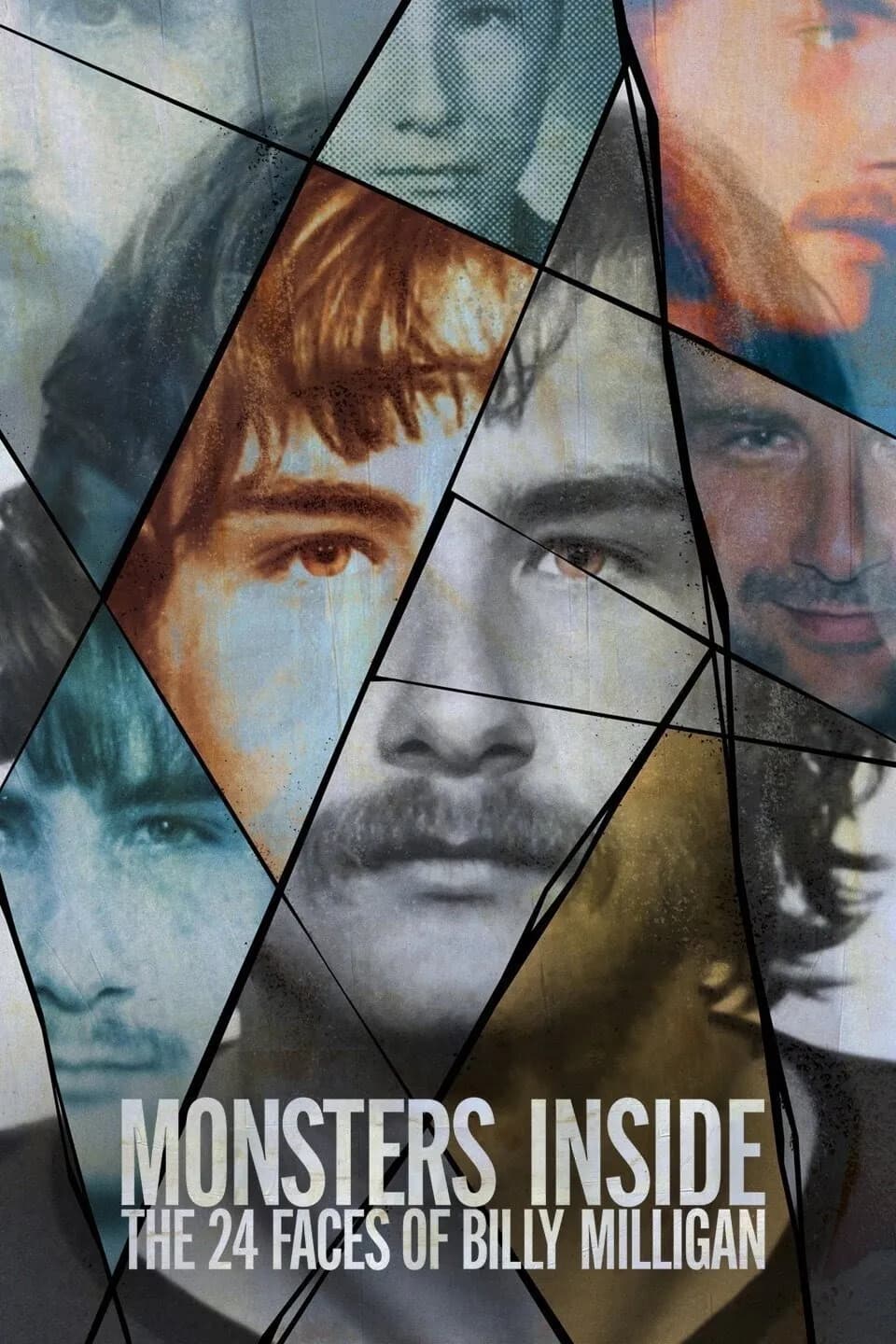
Monsters Inside: The 24 Faces of Billy Milligan
Netflix, 2021 — the landmark insanity defense case of Billy Milligan in Ohio
Quick facts
What Is the Series About?
Monsters Inside: The 24 Faces of Billy Milligan is a four-episode Netflix documentary series that examines one of the most extraordinary and contested criminal cases in American legal history. Released in 2021 and directed by French filmmaker Olivier Megaton — best known for his work in action cinema — the series chronicles the case of William Stanley Milligan, the Ohio man who in 1978 became the first person in United States history to be acquitted of a major felony by reason of insanity on the grounds of dissociative identity disorder (DID), then still widely referred to as multiple personality disorder.
The series does not merely retell a decades-old case. It interrogates it — examining the psychiatric establishment that validated Milligan's diagnosis, the legal system that accepted it, the victims whose suffering was largely overshadowed by the spectacle of the defense, and the popular culture machinery that transformed a convicted rapist into something approaching a celebrity.
The Case
In 1977, a series of rapes and robberies shook the area around Ohio State University in Columbus, Ohio. Three young women were assaulted and robbed in incidents that police would eventually link to a single suspect. When Billy Milligan was arrested in October 1977, investigators and prosecutors expected a straightforward, if serious, criminal proceeding.
What followed was anything but straightforward.
Milligan's defense attorneys retained a team of psychiatrists who, after extensive evaluation, concluded that their client suffered from multiple personality disorder. According to this testimony, Milligan himself — the core identity — had not committed the crimes. Instead, two of his alternate personalities had acted independently: "Adalana," a 19-year-old lesbian personality said to crave human contact, and "Philip," a petty criminal personality. Milligan, the argument went, had no awareness of or control over what these personalities did.
The psychiatric testimony was extensive and, ultimately, persuasive to the court. In December 1978, an Ohio judge found Billy Milligan not guilty by reason of insanity. Rather than prison, Milligan was committed to a series of psychiatric facilities in Ohio, where he spent the better part of the following decade.
The case drew immediate and intense national attention. Supporters — including psychiatrists and civil liberties advocates — argued it represented a breakthrough in the legal recognition of serious mental illness. Critics, including many in law enforcement and the victims' rights community, argued that the verdict amounted to a system allowing a dangerous predator to escape accountability, and that the victims' suffering had been effectively erased by the narrative surrounding their attacker's condition.
Daniel Keyes, the author best known for Flowers for Algernon, gained extensive access to Milligan and published The Minds of Billy Milligan in 1981. The book brought the case to a mass audience and, for many readers, framed Milligan as a sympathetic, even tragic figure — a framing that the Netflix documentary would later scrutinize critically.
After his release from psychiatric custody in the late 1980s, Milligan lived a largely private and reportedly troubled life. He died on December 12, 2014, at age 59.
The Victims
One of the most persistent criticisms of coverage surrounding the Milligan case — including the Keyes book — is the degree to which the victims have been marginalized. The three women assaulted near Ohio State University in 1977 were not afforded the same public platform, narrative arc, or cultural memory as their attacker. Monsters Inside has been noted by reviewers for at least attempting to foreground this imbalance, incorporating perspectives on how the legal spectacle surrounding Milligan's diagnosis effectively displaced the victims from their own case. Their names have not been widely published in public reporting, and their identities remain appropriately protected.
Production
The series was directed by Olivier Megaton, whose background is primarily in big-budget action films — most notably entries in the Taken and Transporter franchises — making his involvement in a psychological true-crime documentary an unusual creative pivot. Netflix acquired and produced the series for global release in 2021.
The four-episode format allows the series to cover significant ground: Milligan's traumatic childhood and early life, the crimes themselves, the extraordinary legal proceedings, the psychiatric debate around his diagnosis, the cultural aftermath of the Keyes book, and the broader questions about how the American justice system handles defendants with severe mental illness.
The documentary draws on archival footage, contemporary interviews, and case materials accumulated over decades. Notably, the series benefits from the long paper trail the Milligan case generated — court records, psychiatric evaluations, and the extensive reporting that followed the 1978 verdict — while also engaging voices critical of how the case was handled and remembered.
Reception
The series generated significant viewer engagement upon its 2021 Netflix release, driven in part by the inherently sensational nature of its subject matter and in part by renewed public interest in true crime as a genre. Audience reactions were sharply divided along predictable lines: viewers fascinated by the psychology and the legal precedent on one side, and viewers troubled by the potential for the documentary format to inadvertently glamorize a man convicted — at least in a factual sense — of serious sexual violence on the other.
Critical reception reflected similar tensions. Reviewers acknowledged the series' ambition and its willingness to engage with uncomfortable questions about victims, mental illness, and media narratives. However, some critics noted that even a documentary framed as skeptical of the Milligan mythology risks perpetuating it simply by dedicating four hours of premium streaming real estate to his story. The direction, coming from a filmmaker without a background in documentary or journalism, was noted as occasionally uneven in tone.
The series has no widely reported IMDb rating available for verification at time of publication.
The Case Today
Billy Milligan died in 2014, but the questions his case raised have not been resolved. The insanity defense remains one of the most debated provisions in American criminal law, rarely invoked and even more rarely successful. The specific question of dissociative identity disorder as a legal defense has been scrutinized repeatedly in the decades since the Milligan verdict, with forensic psychiatrists divided on questions of diagnosis, simulation, and legal culpability.
The case also sits at an uncomfortable intersection with the #MeToo era's reassessment of how the legal system and media have historically treated survivors of sexual violence. The three women assaulted in Columbus in 1977 received a verdict that, by any conventional measure, denied them justice in the criminal sense. Whether the psychiatric and legal framework that produced that outcome represented genuine progress or a profound failure of accountability is a question Monsters Inside raises — and, as with the case itself, leaves productively unresolved.