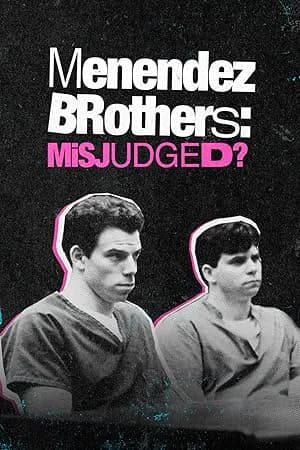
Menendez Brothers: Misjudged?
HBO Max, 2022 — the Beverly Hills parricide case that divided America
Quick facts
What Is the Series About?
Menendez Brothers: Misjudged? is an HBO Max documentary directed by Andrea De Brito and released on 7 August 2022. Running approximately 85 minutes, it revisits one of the most discussed criminal cases in modern American history: the 1989 shotgun murders of José and Mary 'Kitty' Menendez by their sons, Erik and Lyle, at the family's Beverly Hills mansion. The film does not simply rehearse the established facts of the case — it poses a pointed question, embedded in its title, about whether the brothers were judged fairly. It frames that question around a wave of renewed public debate, driven largely by younger audiences on TikTok, who have revisited the case and challenged the original narrative.
The documentary sits squarely in a broader cultural moment. Since the early 2020s, the Menendez case has re-entered mainstream conversation through social media, streaming-platform docuseries, and dramatizations. Misjudged? was among the earlier entries in that renewed wave of content, and it set the terms of debate that subsequent films and series would continue to argue over.
---
The Case
On 20 August 1989, José Menendez and his wife Kitty were shot dead in the den of their Beverly Hills home. Both were killed by shotgun fire at close range. Their sons, Lyle (then 21) and Erik (then 18), reported finding the bodies later that evening and initially told police they believed an organized crime connection of their father's was responsible.
José Menendez was a high-profile entertainment executive. The family was wealthy and socially prominent, which ensured that the case attracted significant press attention from the outset. But it was the eventual defense strategy — and the televised trial that followed — that transformed the Menendez case into a cultural phenomenon.
The brothers were arrested in March 1990 after Erik's therapist informed law enforcement that Erik had confessed to the killings. When the case came to trial in 1993, the defense argued that Erik and Lyle had been subjected to years of physical and sexual abuse by their father, and that the murders were a desperate act of self-preservation by two young men who believed their lives were in danger. Prosecutors argued the motive was financial: the brothers stood to inherit millions.
The 1993 trial was broadcast on television and became one of the defining media spectacles of the decade. The first proceeding ended in deadlocked juries and mistrials. At retrial, the brothers were convicted of first-degree murder in 1996 and sentenced to life in prison without the possibility of parole — sentences they continue to serve today.
The central tension the documentary explores has never been fully resolved in public perception: were Erik and Lyle cold-blooded killers motivated by greed, or were they abuse survivors whose trauma was systematically minimized by the justice system? That unresolved question is precisely what the film's interrogative title signals.
---
Production
The documentary was directed by Andrea De Brito, whose approach centers the film on contemporary voices re-evaluating the case rather than relying solely on archival trial footage. The film leans into the generational divide in how the case is understood: older audiences who followed the original trials tend to remember the verdict as just; younger viewers, particularly those who encountered the story through TikTok and social media, are more likely to emphasize the abuse allegations and question whether the brothers received a fair trial.
The 'Free Menendez Movement' — a loose, largely TikTok-based advocacy community — features prominently in the documentary's framing. De Brito uses this grassroots campaign as a lens through which to re-examine the original proceedings, asking whether evidence of abuse was adequately weighed by the courts and whether the media circus surrounding the televised trial distorted public and jury perception.
At 85 minutes, the film is structured as a single feature-length documentary rather than a multi-episode series, giving it the pacing of a focused argument rather than an expansive chronicle.
---
Reception
Menendez Brothers: Misjudged? holds an IMDb rating of 5.8 out of 10, reflecting a divided audience response. Critics and viewers who found the documentary valuable tended to praise its engagement with the social media dimension of the case's revival and its willingness to foreground the abuse narrative that the defense had raised at trial. Those less persuaded by the film argued that it weighted the brothers' perspective too heavily without adequately representing the prosecution's case or the victims.
According to The Wrap, the documentary is among the key titles viewers sought out in the context of renewed Menendez-related streaming content. That renewed interest accelerated significantly with later dramatizations and docuseries, which brought fresh audiences to the underlying case and, by extension, back to earlier documentary treatments like Misjudged?
The broader controversy the film participates in is long-standing: whether the abuse claims made by the defense were credible, whether they were fairly evaluated by the jury, and whether the life sentences handed down in 1996 remain proportionate given what is now better understood about the psychology of abuse survivors. These questions have not been settled, and the film's provocative framing — the question mark in the title — reflects that ongoing uncertainty.
---
The Case Today
As of the time of the documentary's release, Erik and Lyle Menendez remained incarcerated in California state prison, serving their life sentences without the possibility of parole. The case has periodically attracted renewed legal attention, with the brothers filing petitions and motions over the years, though no successful appeal had altered their sentences.
The social media revival documented in Misjudged? has had tangible downstream effects. The 'Free Menendez Movement' that the documentary chronicles helped sustain public pressure on the question of whether the case should be reconsidered. Several subsequent documentary projects and dramatic productions revisited the same material, each contributing to an ongoing public debate that shows no sign of reaching consensus.
The case remains, as multiple sources have noted, one of the most famous and most contested true-crime cases of the late twentieth century in the United States — a story that continues to generate argument precisely because the facts at its core, including what happened in the Menendez household in the years before the murders, have never been definitively established to everyone's satisfaction.