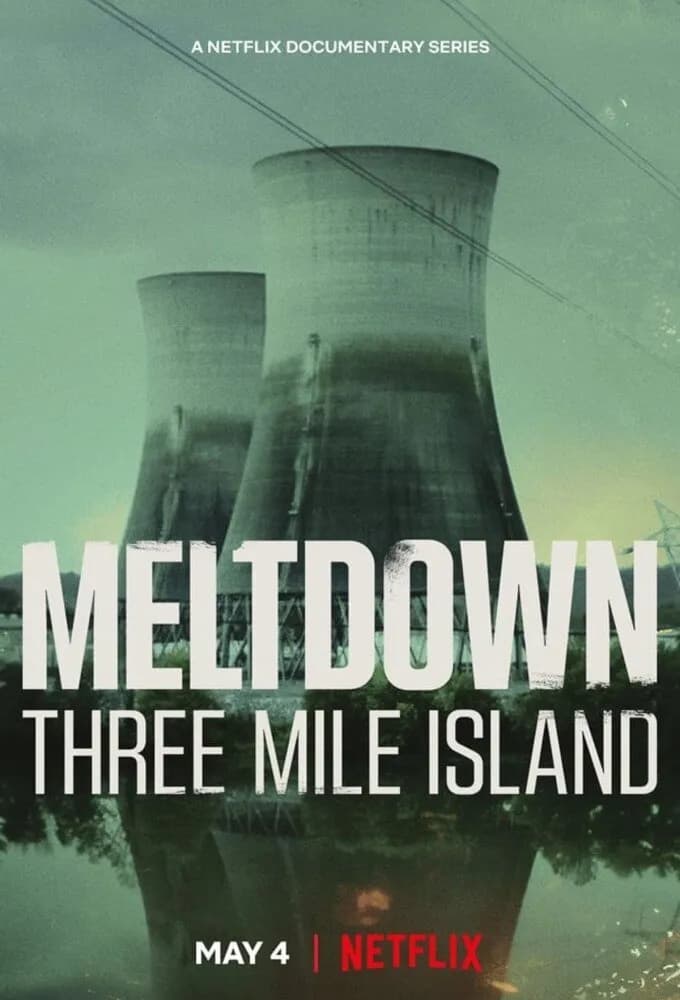
Meltdown: Three Mile Island
Netflix, 2022 — the 1979 nuclear accident, its cover-up allegations, and the whistleblower who refused to stay silent
Quick facts
What Is the Series About?
*Meltdown: Three Mile Island* is a four-part Netflix documentary series that examines the 1979 partial nuclear meltdown at the Three Mile Island Nuclear Generating Station near Middletown, Pennsylvania — the most serious nuclear accident in United States history — and the decade of controversy, alleged concealment, and whistleblowing that followed. Directed by Kief Davidson and released on May 4, 2022, the series sits at the intersection of industrial disaster documentary and investigative journalism rather than the conventional true-crime format. It is rated TV-14 and is classified by Netflix as a Limited Series.
Unlike a standard true-crime series built around a murder or assault, Meltdown: Three Mile Island investigates what its subjects describe as corporate malfeasance, regulatory failure, and a national cover-up — allegations that were never resolved through a criminal trial but that shaped American nuclear policy and public trust for decades.
---
The Accident and Its Aftermath
At approximately 4:00 a.m. on March 28, 1979, a combination of mechanical failure and operator error caused the Unit 2 reactor at Three Mile Island to lose coolant, leading to a partial meltdown of the reactor core. Pennsylvania Governor Dick Thornburgh advised pregnant women and young children within five miles of the plant to evacuate, and an estimated 140,000 residents fled the Harrisburg area voluntarily. The incident paralyzed the U.S. nuclear industry and became a defining moment in the history of energy policy.
Official investigations ultimately concluded that no deaths or direct injuries were caused by radiation released during the accident — a finding the series presents alongside community members and scientists who dispute the long-term health picture. Because no individuals were criminally charged in connection with the accident itself, there is no perpetrator, no trial, and no verdict at the center of this story. Instead, the documentary's dramatic engine is the question of what happened after the cameras left: specifically, whether the cleanup of Unit 2 was conducted safely and honestly.
The series builds its case through the testimony of Rick Parks, a nuclear engineer and whistleblower who worked directly on the TMI cleanup throughout the 1980s. Parks alleges that the cleanup process was rushed and that safety violations were concealed from the Nuclear Regulatory Commission and the public. His federal whistleblower complaint, filed in the mid-1980s, is treated by the documentary as evidence of a pattern of institutional dishonesty rather than an isolated incident.
Other on-screen voices include Lake Barrett, a former NRC official who supervised aspects of the cleanup; Eric Epstein, a longtime activist and watchdog for communities near TMI; and Michio Kaku, the theoretical physicist and science communicator, who contextualizes the accident's technical dimensions. Together, these perspectives construct a portrait not of a single villain but of a system — corporate, regulatory, and political — that the filmmakers argue prioritized reputation over public safety.
---
Production
Director Kief Davidson, known for documentary work on subjects ranging from child soldiers to the music industry, approached Three Mile Island as a story of institutional accountability and individual courage. The series draws on dramatic reenactments, archival footage, never-before-seen home video, and in-depth interviews to reconstruct both the chaotic hours of the initial accident and the quieter, more complicated story of the cleanup years.
Producer Carla Shamberg worked alongside Davidson to secure access to Parks and other insiders who had not previously spoken on camera at length. The decision to center the narrative on Parks — rather than on the accident's technical details alone — gives the series a human-scale tension more typical of whistleblower thrillers than standard science documentaries. The four-episode structure allows the series to move chronologically: from the night of the accident, through the immediate crisis and evacuation, into the long cleanup, and finally to the present-day legacy of the plant and its community.
---
Reception
The series drew significant attention on Netflix following its May 2022 release, particularly given renewed public interest in nuclear energy as a climate solution and ongoing debates about plant safety. A review in *The Guardian* highlighted the documentary's effectiveness in conveying the stakes of the whistleblower narrative and the continuing danger posed by inadequate regulatory oversight, calling it a tense and necessary revisitation of an underexamined chapter of American history.
The Philadelphia Inquirer treated the series as an opportunity for regional audiences to re-examine an event that had been part of local memory for decades, while 6abc Action News covered the series' impact on renewed conversations about the plant's legacy in Pennsylvania.
The documentary is not without controversy. A YouTube fact-check and review video argues that the series contains bias and misinformation, suggesting that its framing of the accident's health consequences and the cleanup's dangers goes beyond what the scientific consensus supports. Critics in this vein contend that the documentary leans on the most alarming interpretation of contested data without adequately representing the official findings that radiation releases were within tolerable limits. These objections reflect a broader and ongoing dispute in the scientific and policy communities about how to communicate nuclear risk to the public.
The IMDb title page lists the series as Meltdown: Three Mile Island (TV Mini Series 2022) with title ID tt19757508, though no aggregate audience rating figure was available at time of publication.
---
The Case Today
Three Mile Island Unit 2 has never returned to operation. Unit 1, which was undamaged in the 1979 accident, operated until 2019, when it was shut down for economic reasons. In a striking postscript that the documentary could not have anticipated, Constellation Energy announced plans in 2023 to restart Unit 1 to supply power to Microsoft data centers — a development that reignited every debate the series raises about safety culture, regulatory oversight, and community consent.
Rick Parks, whose testimony is central to the documentary, remains one of the most prominent voices in U.S. nuclear whistleblower history. No criminal charges were ever filed against Metropolitan Edison, GPU Nuclear, or any individual in connection with the accident or the cleanup allegations. The controversy Parks brought to light was resolved — to the extent it was resolved at all — through regulatory proceedings and civil channels rather than through the criminal justice system.
For communities near Harrisburg, the accident and its legacy remain a living issue rather than a closed chapter of history. Meltdown: Three Mile Island functions, ultimately, as both a historical record and an argument: that the systems designed to protect the public failed in 1979, and that the failure was compounded, not corrected, in the years that followed.