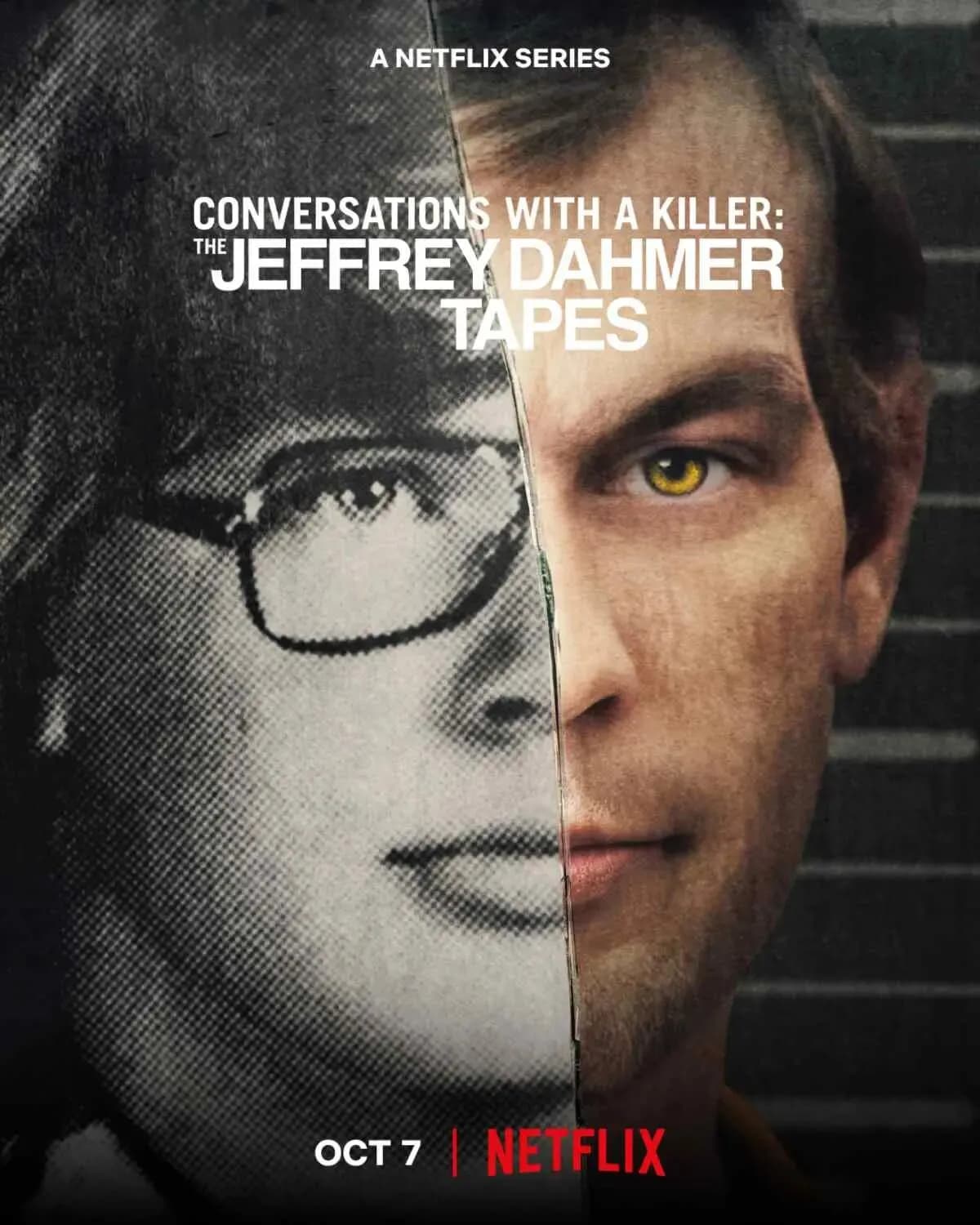
Conversations with a Killer: The Jeffrey Dahmer Tapes
Netflix, 2022 — The Milwaukee serial killer's confessions and the systemic failures behind 17 murders
Quick facts
What Is the Series About?
Conversations with a Killer: The Jeffrey Dahmer Tapes is a Netflix docuseries that examines the criminal case of Jeffrey Lionel Dahmer — the Milwaukee serial killer who murdered, dismembered, and in some cases cannibalized 17 boys and men between 1978 and 1991. Released on October 7, 2022, the three-episode series is directed by Joe Berlinger and is distinguished from conventional true-crime productions by its heavy reliance on audio recordings: taped conversations Dahmer conducted with his own defense team, capturing his confessions in his own voice. Rather than reconstructing events purely through reenactment, Berlinger centers those recordings as the primary documentary evidence, allowing viewers to hear Dahmer describe his crimes in unsettling and graphic detail.
The series arrives as the second entry in Berlinger's Conversations with a Killer franchise on Netflix, following earlier installments focused on Ted Bundy and John Wayne Gacy. It also landed in the immediate wake of Ryan Murphy's scripted dramatization Dahmer – Monster: The Jeffrey Dahmer Story, a timing that intensified public attention on both projects and drew inevitable comparisons.
The Case
Jeffrey Lionel Dahmer was born on May 21, 1960, in Milwaukee, Wisconsin. His first known murder took place in 1978 in Bath Township, Ohio, where he killed Steven Hicks after a chance meeting. That crime went undetected for years. Dahmer's killing accelerated through the 1980s and into 1991, primarily in Milwaukee, where he lured victims — predominantly queer men of color — to his apartment, drugged them, killed them, and in numerous instances dismembered, photographed, and in some cases consumed their remains.
The case broke open on July 22, 1991, when Milwaukee police entered Dahmer's Oxford Apartments unit after Tracy Edwards, a man who had managed to escape, flagged down officers on the street. Inside, investigators discovered a scene that became one of the most disturbing crime discoveries in American history: skulls, preserved organs, photographs of dismembered bodies, and other human remains. Dahmer confessed rapidly and comprehensively — admitting to sixteen murders in Wisconsin and one earlier murder in Ohio, a total of 17 victims.
His victims were boys and men, the majority of them queer men of color, drawn from communities that the series argues were systematically underserved and overlooked by law enforcement. The docuseries does not shy away from documenting one of the case's most damning episodes: in May 1991, two months before the arrest, 14-year-old Konerak Sinthasomphone had escaped Dahmer's apartment and was found disoriented in the street by neighbors, who called 911. Officers responded but accepted Dahmer's story that the boy was an adult companion, and returned him to the apartment. Sinthasomphone was subsequently murdered. That incident became a focal point for criticism of the Milwaukee Police Department's conduct throughout the investigation.
Following his trial, Dahmer was convicted on all murder counts and sentenced to 16 consecutive life terms. He was killed on November 28, 1994, by fellow inmate Christopher Scarver at the Columbia Correctional Institution in Portage, Wisconsin.
Production
Director Joe Berlinger, whose true-crime documentary work includes Paradise Lost: The Child Murders at Robin Hood Hills and the Conversations with a Killer series, built this docuseries around audio recordings that Dahmer made with his defense attorneys in the lead-up to his 1992 trial. Those tapes had not previously been given such prominent documentary treatment. Netflix describes the series as an exploration of Dahmer's own confessions to his gruesome crimes, while framing it simultaneously as an account of broader systemic failure — the policing failures, racial dynamics, and social marginalization that allowed Dahmer to operate for over a decade.
Beyond the Dahmer recordings, the series incorporates archival news footage, interviews with investigators, journalists, and community members, and material drawn from court proceedings. Berlinger's structural approach uses Dahmer's voice not to humanize him but to contextualize him within the social environment that, as the series argues, made his crimes possible for so long.
Reception
Critical reception to Conversations with a Killer: The Jeffrey Dahmer Tapes was mixed to lukewarm. The Chicago Sun-Times described the series as lurid and unsettling, noting its heavy dependence on Dahmer's own taped statements as both its primary strength and its central ethical problem. Critics across outlets observed that while the series attempts to foreground the victims' communities and expose the failures of policing — particularly around race, sexuality, and class — it nonetheless structurally centers Dahmer's voice, a tension at the heart of much contemporary true-crime debate.
The series drew significant viewership partly because it released just weeks after Dahmer – Monster: The Jeffrey Dahmer Story, which had generated enormous audience figures for Netflix. The proximity of the two projects sharpened scrutiny of both, with commentary focused on whether the volume of Dahmer content on one platform crossed a line from documentary interest into exploitation. Common Sense Media flagged the graphic nature of the content — including detailed discussions of murder, sexual violence, necrophilia, and cannibalism — and cautioned accordingly. An official IMDb rating had not been confirmed in the sources used for this article.
The Case Today
Jeffrey Dahmer has been dead since 1994, and no legal proceedings remain open in connection with his crimes. The lasting impact of the case, however, continues to generate discussion — particularly around the Milwaukee Police Department's conduct before and during the investigation, including the Konerak Sinthasomphone incident and broader patterns of how reports from communities of color were handled. Several Milwaukee officers were disciplined or dismissed in connection with the handling of that specific call, though critics argued the accountability measures were insufficient.
The families of Dahmer's victims have spoken publicly on multiple occasions about the pain caused by repeated dramatizations and documentary treatments of the case, raising questions about consent, dignity, and the ethics of the true-crime genre more broadly. Those concerns were renewed in 2022 when both the Murphy scripted series and Berlinger's docuseries appeared in rapid succession. The conversation around how the entertainment industry handles cases rooted in the murders of marginalized men — particularly queer men of color — remains unresolved, and Conversations with a Killer: The Jeffrey Dahmer Tapes sits squarely at the center of that ongoing debate.