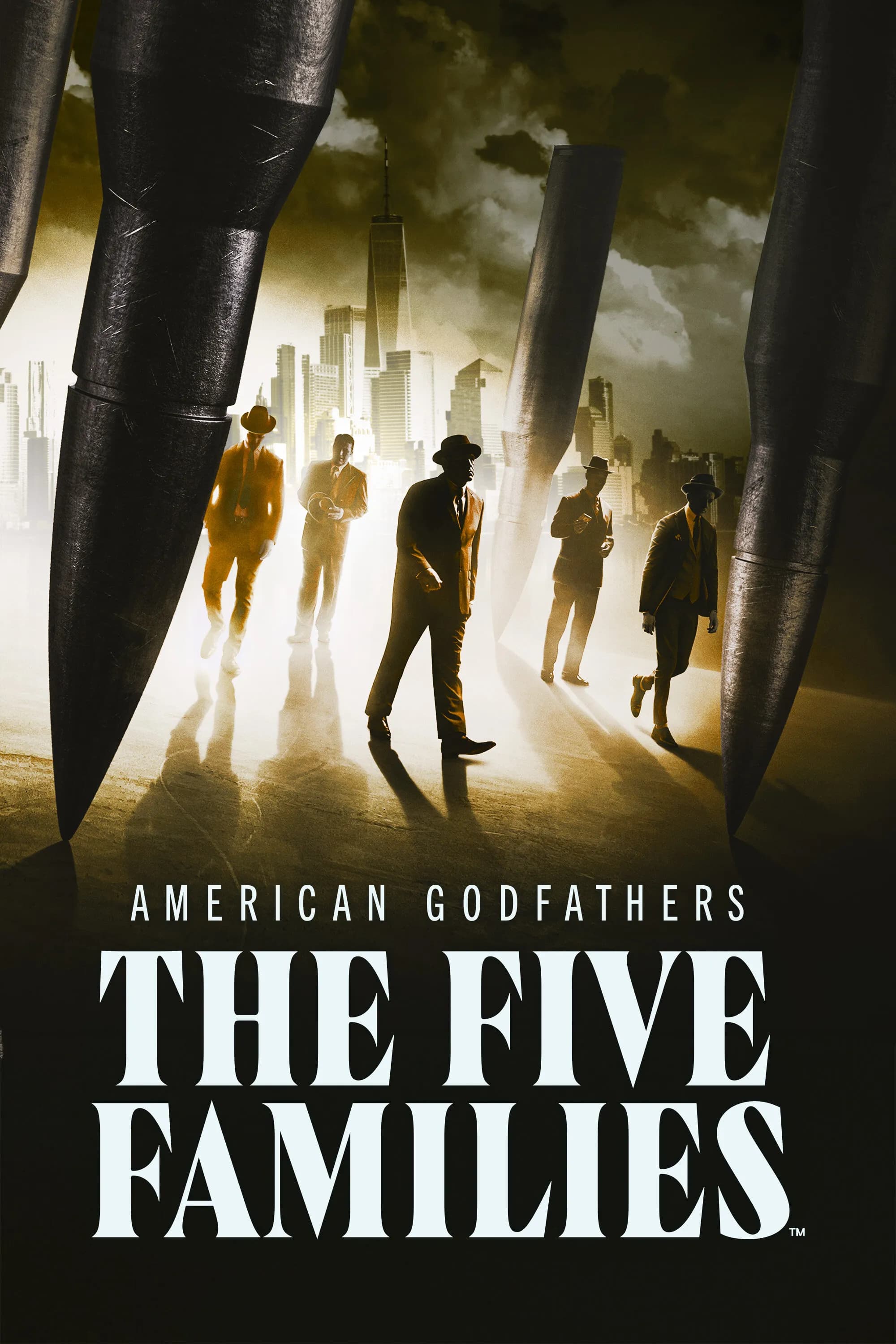
American Godfathers: The Five Families
Amazon, 2024 — The rise and fall of New York's five Mafia dynasties across seven decades
Quick facts
What Is the Series About?
American Godfathers: The Five Families is a 2024 documentary miniseries available on Amazon Prime Video that chronicles seven decades of New York City's most powerful organized crime dynasties — the Gambino, Genovese, Lucchese, Bonanno, and Colombo families. Structured as three episodes running approximately six hours in total, the series is one of the most ambitious documentary treatments of American Mafia history produced for streaming, drawing on a wealth of archival footage, law-enforcement testimony, and the foundational scholarship of journalist Selwyn Raab's book Five Families.
Unlike single-case true crime documentaries focused on one perpetrator and one victim, this series operates as a sweeping historical panorama. It traces how five distinct criminal organizations carved up New York City — and, by extension, much of the United States — into territories of extortion, loansharking, narcotics trafficking, labor racketeering, and murder, and how they ultimately bent under the weight of federal prosecution and internal betrayal.
The Case
There is no single crime at the center of American Godfathers: The Five Families. Instead, the series documents the collective criminal enterprise of the New York Cosa Nostra across the better part of the twentieth century.
The five families depicted each had their own leadership structure, earning streams, and internal culture, but all operated under a shared governing body known as the Commission — a board of bosses that arbitrated disputes and set policy for organized crime nationally. The Wikipedia entry on the Five Families describes the Commission's founding in the early 1930s under Charles "Lucky" Luciano as the moment when American organized crime became a true institutional power rather than a collection of warring street gangs.
Key figures covered in the series include:
- Vito Genovese — the boss who gave the Genovese family its name, convicted on federal narcotics charges in 1959 and died in a federal prison in 1969.
- Carlo Gambino — the quiet, ruthless boss of the Gambino family who avoided prison and died of natural causes in 1976, at the height of his power.
- Tommy Lucchese — the Lucchese family boss who maintained a low profile for decades and died in 1967, never having served a significant prison sentence.
- Joseph Bonanno — the Bonanno boss who survived decades of internal power struggles and lived until 2002, eventually writing a memoir that scandalized his former associates.
- Joseph Colombo — the Colombo boss who controversially founded the Italian-American Civil Rights League before being shot in the head at a public rally in 1971; he lingered in a severely disabled state until his death in 1978.
The pivotal turning point in the documentary's narrative arc is the 1963 Senate testimony of Joseph Valachi, a low-level Genovese soldier who became the first made member of the American Mafia to publicly confirm its existence and describe its structure to the U.S. government. Valachi's testimony was a watershed moment: it named the Five Families, described the initiation ritual, and gave federal law enforcement the roadmap it needed to begin dismantling Cosa Nostra from the inside. Valachi died in federal custody in 1971.
The series also covers the long arc of federal racketeering prosecutions that followed, including the landmark 1986 Mafia Commission Trial, in which the U.S. Attorney's office under Rudy Giuliani used the RICO statute to convict the bosses of four of the five families simultaneously — an event widely considered the beginning of the end for the New York Mob's golden era.
Production
The series is listed on IMDb under title ID tt33054614 and was released in the United States on August 11, 2024. The production is notable for having Michael Imperioli — best known for playing Christopher Moltisanti on The Sopranos — attached as executive producer, lending the project both cultural credibility and a direct link to the most celebrated fictional treatment of the American Mafia. The director of the series is not identified in available promotional materials.
The documentary draws heavily on Selwyn Raab's exhaustively researched book Five Families: The Rise, Decline, and Resurgence of America's Most Powerful Mafia Empires, which remains the definitive journalistic account of the subject. The series supplements that historical framework with archival news footage, FBI surveillance recordings, and interviews with former law-enforcement officials and organized crime historians.
According to coverage in Newsday, the production was initially associated with History Channel before finding its primary streaming home on Amazon, which may explain the inconsistent platform listings that have appeared across Apple TV, Netflix, and Amazon storefronts since its release.
Reception
The series earned an IMDb rating of 7.6/10, reflecting a broadly positive audience response. Viewer engagement has been strong: a Reddit thread in the r/Mafia community highlighted significant discussion around the series' three-part, six-hour format, with many commenters praising its scope while others debated how much new ground it broke for viewers already familiar with Mafia history.
ComicBook.com noted that the series became an "instant success" after appearing on streaming platforms, partly because it answers a question millions of Godfather fans have long asked: who were the real men that Mario Puzo and Francis Ford Coppola drew on when they created Don Corleone and the Corleone family? The answer, the documentary makes clear, is not one man — it is five families, dozens of bosses, and nearly a century of organized criminal enterprise.
No major critical controversies have been documented in connection with the series. The most notable complication has been the inconsistency of its streaming availability, with the title appearing and disappearing from multiple platforms including Apple TV and Netflix in addition to its primary Amazon home.
The Case Today
The five families themselves still nominally exist, though they operate as pale shadows of their mid-twentieth-century power. Decades of RICO prosecutions, witness cooperation agreements, and the erosion of the labor and waterfront rackets that once funded them have left the New York Mob a diminished force. The Gambino, Genovese, and Lucchese families retain some street-level presence, but the era of Commission meetings, multi-borough territorial control, and near-immunity from prosecution is long over.
Joseph Valachi, whose Senate testimony forms one of the documentary's central turning points, died in federal custody in 1971. His decision to cooperate with the government set a precedent that would be followed by far more damaging informants in subsequent decades — most notably Henry Hill, whose story was told in Goodfellas, and Salvatore "Sammy the Bull" Gravano, whose testimony helped convict Gambino boss John Gotti in 1992.
American Godfathers: The Five Families arrives at a moment when public appetite for Mafia history remains undiminished, even as the actual Mafia recedes further from its peak power. For viewers who want to understand the real criminal world that gave birth to some of the most celebrated fiction in American popular culture, the series offers a thorough and accessible entry point.