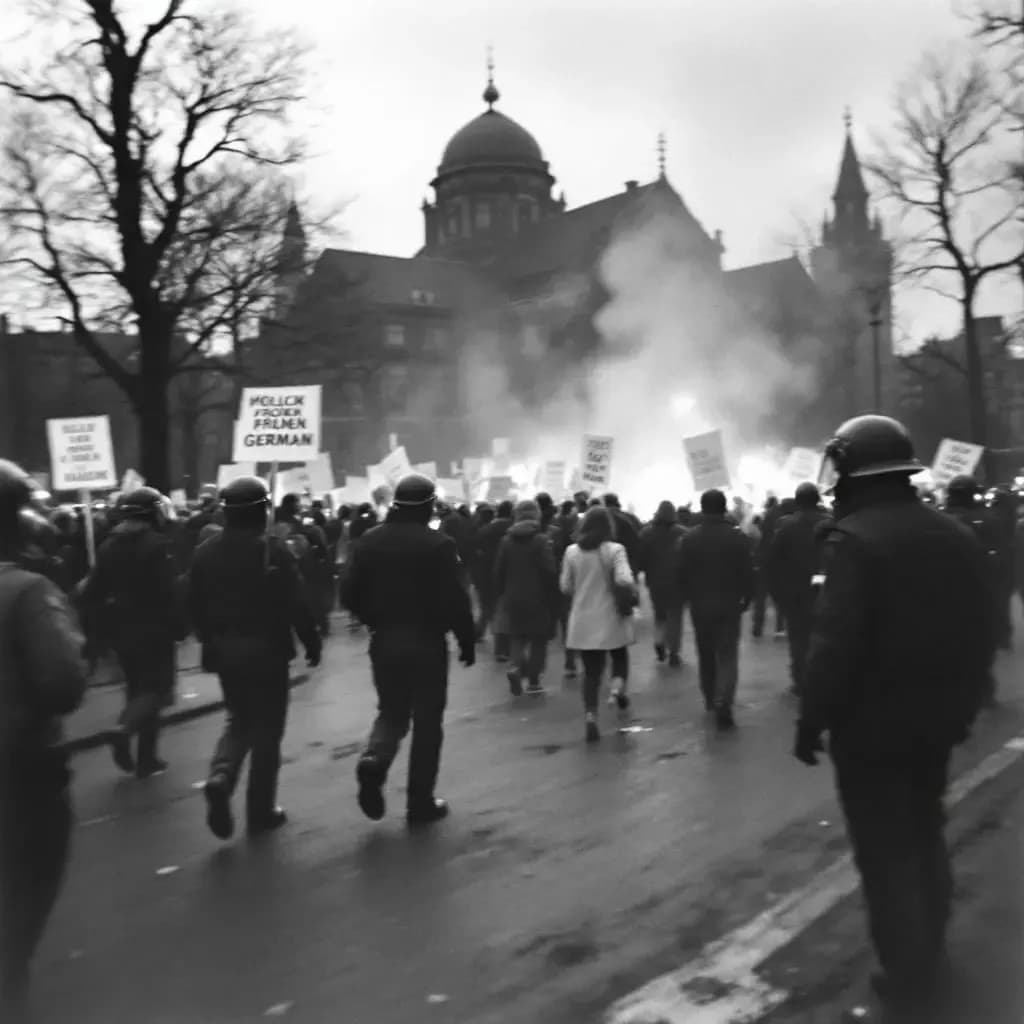
The Baader-Meinhof Complex: The Film That Rewrote History
When Germans discuss the Red Army Faction today, they often speak through the lens of Uli Edel's film. "Der Baader-Meinhof Komplex" from 2008 became far more than a successful film production—it became the work through which entire generations understand one of the darkest chapters in postwar European history.
Edel's ambitious 150-minute drama traces the RAF's trajectory from the student movement of 1967 through the bloody "German Autumn" of 1977. The film came to define not only how Germany remembers its own extremism, but how the world perceived this left-wing terrorist organization.
A Film That Posed Questions
When "Der Baader-Meinhof Komplex" premiered in 2008, the reaction was almost immediate. Here was a German director willing to tackle this hypersensitive history without compromise—neither glossing over the idealism nor the bloodshed.
The film received an Oscar nomination for Best Foreign Language Film and won multiple German film awards. But the accolades were not the most important aspect. What mattered was that Edel had managed to make a complex piece of German history cinematically accessible without resorting to black-and-white thinking.
The film functioned as far more than a stylish terrorism thriller. Instead, it presented a nuanced narrative about how idealistic young people could slip into the logic of armed rebellion. For many Danish and German filmgoers, this film became their dominant visual memory of the RAF—a responsibility Edel took seriously.
Actors Gave the Characters Soul
Edel's casting was exceptional. Martina Gedeck portrayed Gudrun Ensslin as rational and analytical, while Moritz Bleibtreu embodied the charismatic and impulsive Andreas Baader. Johanna Wokalek presented the fragile Susanne Albrecht—the daughter from a privileged background who joined the RAF.
These three carried the film's emotional weight and made the characters comprehensible to audiences without glorifying them. Bruno Ganz as lawyer Horst Mahler and the rest of the strong ensemble gave the entire production a gravity that demonstrated German cinema was ready to face this past directly.
Historical Precision Meets Cinematic Drama
Edel's film was based on Gerhard Stern's 1985 nonfiction book, which provided the project with a solid historical foundation. Key events were followed chronologically: the arson attack of 1967, Andreas Baader's spectacular prison break in 1970, bank robberies, hostage situations and assassinations, and the tragic deaths in Stuttgart-Stammheim in 1977.
However, cinematic compression necessitates changes. For dramatic purposes, the narrative had to be compressed, meaning some details were simplified or combined. RAF experts and historians debated fiercely whether Edel had adequately presented the complexity of the ideology, or whether the film placed too much emphasis on psychological profiles and personal conflicts. Nevertheless, the film proved to remain factually accurate on the essential points.
Controversy Over Terror on Screen
The film was not without criticism. Some accused Edel of humanizing RAF members and thereby inadvertently glorifying them. The question of whether one may portray terrorists on screen as fully developed human beings with emotions and contradictions became heated.
Others argued that precisely this human dimension was necessary to understand how the RAF could emerge—that members were not wild fanatics from nowhere, but products of a specific historical situation. Understanding extremism and society requires this perspective.
Edel's depiction of violence was neither voyeuristic nor softened—it was coolly documentary in a way intended to disturb. This approach was respectful to the victims, even if some viewers found themselves overwhelmed by its intensity.
A Film That Still Informs
Since 2008, "Der Baader-Meinhof Komplex" has etched itself deeper into German cinematic and historical consciousness. Schools show film excerpts in lessons. Discussions about the RAF are often conducted through references to scenes from the film. New generations who did not experience the 1970s form their understanding of Andreas Baader, Gudrun Ensslin, and the RAF substantially through Edel's film.
It is a great responsibility the film carries—and apparently it bears it with dignity. Uli Edel has erected a monument that forces reflection without manipulation. In an age when extremism again grows at society's margins, this film remains a cautionary reminder of how quickly idealistic rage can transform into deadly violence.