False confession
A confession to a crime that the confessor did not commit, or a deliberately false admission of guilt made to law enforcement or judicial authorities.
Definition
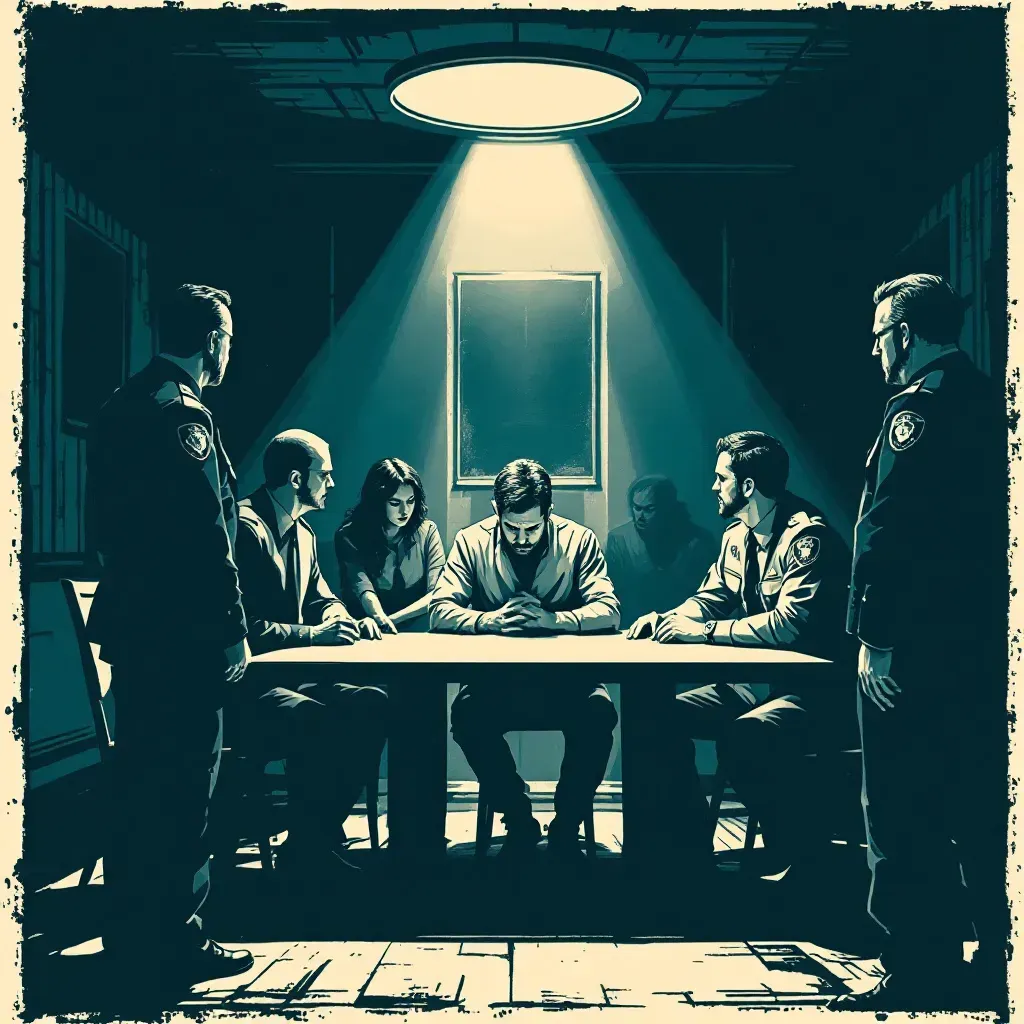
A false confession is an admission of guilt for a criminal act that the person confessing did not commit, or a knowingly fabricated statement admitting to facts that are untrue. False confessions can be voluntary, coerced-compliant (made to escape interrogation pressure), or coerced-internalized (where the suspect comes to believe they committed the crime). In true crime contexts, false confessions have led to numerous wrongful convictions and are recognized as a significant factor in miscarriages of justice.
In federal criminal law, the act of making a false confession or false statement to federal authorities is primarily addressed under 18 U.S.C. § 1001, which criminalizes knowingly and willfully making materially false, fictitious, or fraudulent statements to federal agencies or in matters within federal jurisdiction. A person who deliberately confesses falsely to a federal investigator can be prosecuted under this statute, facing up to five years imprisonment, or up to eight years if the false statement relates to terrorism.
False confessions are distinct from the legal concept of a coerced confession, which may be true but obtained through improper means and therefore inadmissible under the Fifth Amendment's protection against self-incrimination. Courts exclude coerced confessions regardless of their truthfulness because they violate constitutional due process. False confessions, however, may be voluntarily given or obtained through psychologically coercive interrogation techniques that do not necessarily rise to the level of constitutional violation.
Research into false confessions has identified several risk factors, including youth, intellectual disability, mental illness, lengthy interrogations, deceptive interrogation tactics, and the absence of legal counsel. Psychological studies have demonstrated that certain interrogation techniques, such as minimization (downplaying the seriousness of the offense) and maximization (exaggerating evidence or consequences), can lead even innocent individuals to confess falsely. DNA exoneration cases have revealed that approximately 25-30% of wrongful convictions involve false confessions, making them one of the leading causes of proven wrongful convictions in serious crimes.
Related entries
Read more
Henry Lee Lucas — The Confession Killer of Texas
Henry Lee Lucas was an American convicted murderer who became infamous as 'The Confession Killer' after claiming hundreds of murders from Texas custody in the 1980s — most of which were later discredited.
The Beatrice Six — Nebraska's Largest DNA Exoneration Case
The Beatrice Six is a US wrongful-conviction case in which six people were convicted of the 1985 rape and murder of Helen Wilson in Beatrice, Nebraska, then exonerated in 2009 by DNA evidence.
West Memphis Three: 18 Years Imprisoned for Satanic Ritual Murder
Three eight-year-old boys were found murdered in West Memphis, Arkansas on May 6, 1993. Police accused three teenagers of satanic ritual murder based on their clothing style and music taste. The case became a global symbol of wrongful conviction born from moral panic.
Related articles

ABC News Launches Podcast on False Confession and Idaho Murder
ABC News has launched the true crime podcast The Snare, diving into a brutal murder in a small Idaho town, a contested false confession, and one mother's relentless pursuit of justice.

The Snare: A Mother's 30-Year Hunt for Her Daughter's Killer
ABC Audio and 20/20 launched the six-part podcast series 'The Snare' on June 16, 2026, following Biola Dodge's thirty-year campaign to uncover the true killer of her daughter Angie, who was brutally murdered in Idaho Falls, Idaho, in 1996.

Henry Lee Lucas — The Confession Killer of Texas
Henry Lee Lucas was an American convicted murderer who became infamous as 'The Confession Killer' after claiming hundreds of murders from Texas custody in the 1980s — most of which were later discredited.

The Beatrice Six — Nebraska's Largest DNA Exoneration Case
The Beatrice Six is a US wrongful-conviction case in which six people were convicted of the 1985 rape and murder of Helen Wilson in Beatrice, Nebraska, then exonerated in 2009 by DNA evidence.

West Memphis Three: 18 Years Imprisoned for Satanic Ritual Murder
Three eight-year-old boys were found murdered in West Memphis, Arkansas on May 6, 1993. Police accused three teenagers of satanic ritual murder based on their clothing style and music taste. The case became a global symbol of wrongful conviction born from moral panic.
Central Park Five: Five Innocent Teenagers Wrongfully Convicted
On the night of April 19, 1989, Trisha Meili was attacked and raped during a run in Central Park. Five innocent teenagers were wrongfully convicted — and exonerated 12 years later.
When Justice Fails: 10 Wrongful Convictions That Shook Two Nations
Selected by the truecrime.news editorial team as the cases that most powerfully exposed the systemic failures behind wrongful convictions, this list spans two nations and decades of injustice — from fabricated evidence and coerced confessions to tunnel-vision investigations and prosecutorial misconduct.

The Boden Case: Sweden's Dark Summer of 2013
In the summer of 2013, a 20-year-old woman named Vatchareeya disappeared near Boden, Sweden. Her dismembered remains were discovered weeks later in a forest, sparking an investigation that would illuminate serious weaknesses in how Swedish authorities handle violent crime cases.

America's Wrongful Conviction Crisis: A Warning for All Democracies
Since 1989, the U.S. justice system has formally exonerated nearly 3,500 people convicted of crimes they did not commit. Collectively, these innocent people spent almost 32,000 years in prison—a staggering indictment of how flawed eyewitness testimony, prosecutorial misconduct, and official negligence can dismantle the rule of law.

Hackers Steal $570 Million in Binance Coin Cyberattack
Unknown hackers exploited a vulnerability in Binance's BSC Token Hub bridge on October 4, 2022, stealing approximately 2 million BNB tokens valued at $570 million. The attack, discovered two days later, marked one of crypto's largest bridge heists but left user funds untouched.
The Vanishing of Dorothy Arnold
Dorothy Arnold, a 25-year-old New York heiress, vanished in December 1910 from Manhattan. More than a century later, her disappearance remains unsolved, with no trace of what became of her ever discovered.

Colditz Castle: From Royal Residence to Escape-Proof POW Camp
Perched 400 feet above the Mulde River in eastern Saxony, Colditz Castle housed some of World War II's most determined escape artists. Between 1939 and 1945, over 130 prisoners attempted to flee the supposedly inescapable fortress, with dozens succeeding against overwhelming odds.