The Lockerbie Bombing — Pan Am Flight 103 over Scotland
Lockerbie, Scotland, 1988 — partially solved terrorism case
Published June 9, 2026
Case Details
Quick Facts
Classification:
The Case
The Lockerbie bombing stands as one of the deadliest acts of aviation terrorism in history, a case that has spanned more than three decades of investigation, prosecution, and ongoing controversy. On December 21, 1988, Pan Am Flight 103 was destroyed by an explosive device as it flew over the small Scottish town of Lockerbie, killing all 259 passengers and crew members aboard, as well as 11 residents on the ground, for a total of 270 fatalities. The case is classified as partially solved: Libyan intelligence officer Abdelbaset Ali Mohmed al-Megrahi was convicted in 2001, while his co-defendant Lamin Khalifah Fhimah was acquitted. The wider conspiracy behind the attack, including the full extent of state sponsorship and other potential conspirators, remains the subject of legal disputes and historical debate. Some institutional sources describe the investigation as still open, reflecting the unsettled nature of the case more than 35 years after the tragedy.
The Crime
Pan Am Flight 103 departed London Heathrow Airport on the evening of December 21, 1988, bound for New York's JFK International Airport. Aboard the Boeing 747 were passengers from 21 countries, including 35 students from Syracuse University returning home for the Christmas holidays. The aircraft reached its cruising altitude of 31,000 feet over the Scottish Borders when, at 19:02 GMT, a powerful explosion tore through the forward cargo hold.
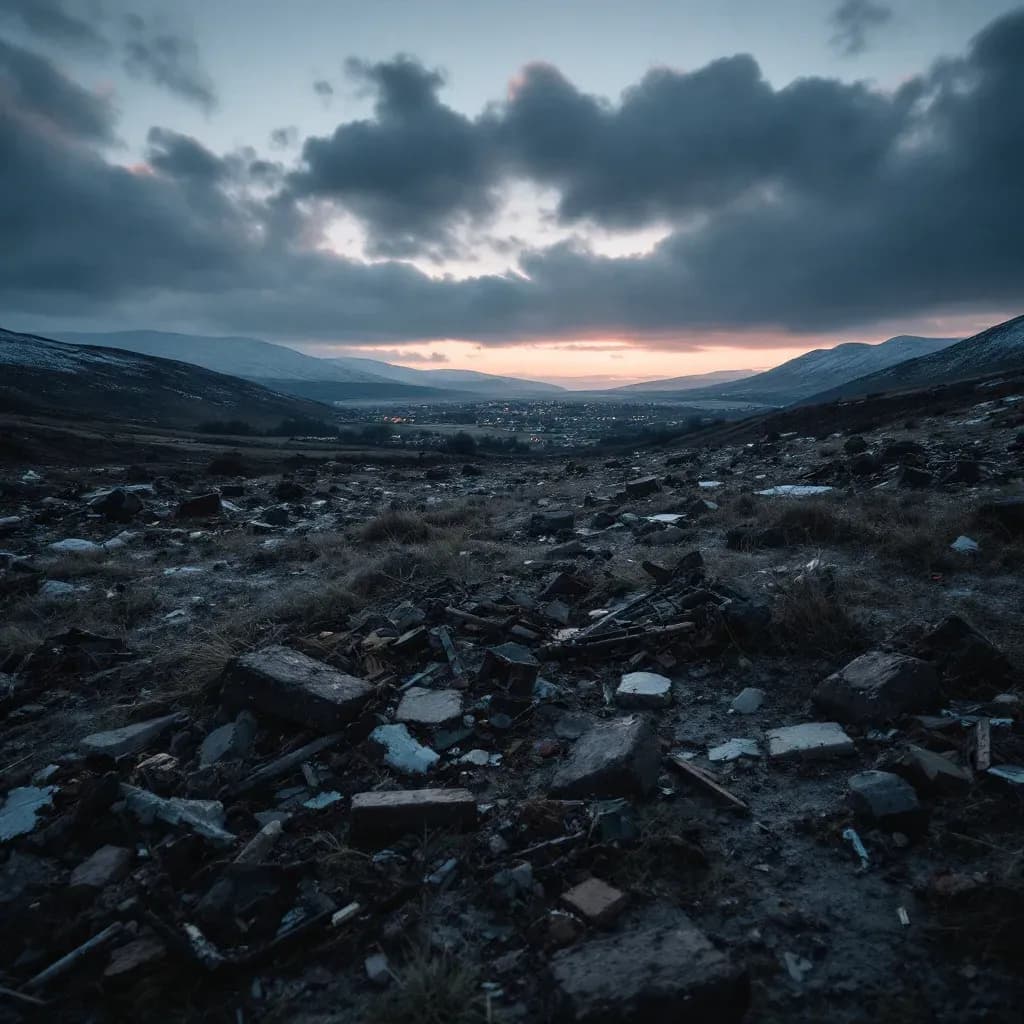
Investigators later determined that a bomb had been planted inside a Toshiba radio-cassette recorder, which was packed in a suitcase and placed in the aircraft's forward cargo hold. The explosive device involved plastic explosives, and the detonation caused catastrophic structural failure. The plane's fuselage broke apart almost instantly, scattering wreckage across 845 square miles of Scottish countryside. The nose section fell relatively intact, while the wings, still laden with fuel, crashed into the Sherwood Crescent area of Lockerbie, creating a massive fireball that destroyed several houses and killed 11 residents instantly.
Timeline
Pan Am Flight 103 explodes over Lockerbie
The Boeing 747 breaks apart at 31,000 feet after a bomb detonates in the forward cargo hold. All 259 people on board and 11 residents on the ground are killed.
International investigation launched
Dumfries and Galloway Constabulary and the FBI launch a joint investigation that over three years would gather approximately 15,000 witness statements.
Charges brought against two Libyan nationals
American and Scottish authorities bring charges against Abdelbaset al-Megrahi and Lamin Khalifah Fhimah, both Libyan intelligence agents, for their alleged role in the bombing.
Trial begins at Camp Zeist
A special Scottish court convenes in the Netherlands to try the two Libyan suspects under Scottish law after years of diplomatic negotiations.
Verdict delivered: one conviction, one acquittal
Al-Megrahi is convicted of mass murder and sentenced to life imprisonment. Fhimah is acquitted due to insufficient evidence of his direct involvement.
Al-Megrahi released on compassionate grounds
Scottish authorities release the terminally ill al-Megrahi to return to Libya, sparking international controversy and protests from victims' families.
Al-Megrahi dies in Libya
The only person convicted for the Lockerbie bombing dies in Tripoli, maintaining his innocence to the end and leaving many questions unanswered.
The scale of the disaster was unprecedented for a British town. Lockerbie, with a population of just over 3,000, was transformed into a vast crime scene. Bodies and debris rained down across the landscape, and the investigation would eventually require the examination of millions of fragments scattered over a huge area.
The Victims
The 270 victims of the Lockerbie bombing represented a cross-section of international travelers. The 259 people aboard the aircraft included American, British, German, Indian, Swedish, and citizens from numerous other nations. The largest single group was American: 189 U.S. citizens perished, including the 35 Syracuse University students who had been studying abroad in London and other European cities during the fall semester.
On the ground, 11 Lockerbie residents were killed when the aircraft's fuel-laden wings struck the Sherwood Crescent neighborhood. Entire families were wiped out in an instant. The youngest victim aboard the aircraft was an infant; the oldest were in their seventies. The passenger manifest included business travelers, families reuniting for the holidays, and students eager to return home. Their deaths would galvanize an international investigation and lead to fundamental changes in aviation security protocols.
Memorial efforts, including those maintained by Syracuse University's archives, have worked to preserve the memory of each individual victim, ensuring that they are remembered not merely as statistics but as people with families, dreams, and futures that were violently cut short.
Investigation
The investigation into the Lockerbie bombing became one of the largest and most complex criminal inquiries in history. A joint effort by the Dumfries and Galloway Constabulary and the FBI, the investigation spanned approximately three years of intensive fieldwork and gathered roughly 15,000 witness statements. Forensic teams painstakingly collected and catalogued millions of pieces of debris, examining each fragment for clues about the explosive device and how it came to be aboard the aircraft.
A critical breakthrough came when investigators discovered fragments of the Toshiba radio-cassette recorder that had housed the bomb, along with pieces of the suitcase in which it had been packed. Among the debris, forensic specialists located a tiny circuit-board fragment that would prove crucial to the case. This fragment was traced back to a specific type of timing device, and intelligence agencies eventually linked it to devices known to have been supplied to Libyan intelligence services.
Investigators reconstructed the bomb's journey: the suitcase containing the device was believed to have been placed aboard an Air Malta flight at Luqa Airport in Malta, then transferred at Frankfurt Airport to a feeder flight, and finally loaded onto Pan Am Flight 103 at Heathrow. This complex routing was apparently designed to evade security checks and obscure the bomb's origin.
On November 13, 1991, after years of painstaking work, indictments were issued against two Libyan nationals: Abdelbaset Ali Mohmed al-Megrahi and Lamin Khalifah Fhimah. Al-Megrahi, born April 1, 1952, in Tripoli, was a Libyan intelligence officer who also served as head of security for Libyan Arab Airlines in Malta. Fhimah was the airline's station manager at Luqa Airport, where the bomb was believed to have begun its journey.
The indictments triggered years of diplomatic deadlock. Libya refused to extradite the suspects, and the United Nations imposed sanctions. It was not until 1999 that an agreement was reached: the two men would be tried before a special Scottish court convened on neutral ground in the Netherlands.
Trial and Verdict
The trial began in May 2000 at Camp van Zeist, a former U.S. military base in the Netherlands that had been temporarily designated Scottish territory for the proceedings. Presided over by three Scottish judges (Scottish law does not use juries in such cases), the trial heard evidence over the course of nine months. Prosecutors presented forensic evidence linking the bomb components to Libya, along with witness testimony placing the defendants in key locations at critical times.
The case against al-Megrahi relied heavily on circumstantial evidence: the circuit-board fragment, records of his travel movements, and testimony from a Maltese shopkeeper who claimed to have sold clothing to a man resembling al-Megrahi—clothing fragments that were later found with the bomb debris. The prosecution argued that al-Megrahi had used his airline security credentials and intelligence training to plant the bomb-laden suitcase at Luqa Airport.
On January 31, 2001, the court delivered its verdict. Al-Megrahi was found guilty of 270 counts of murder and sentenced to life imprisonment with a minimum term of 27 years. Fhimah was acquitted, the judges ruling that the evidence of his direct involvement was insufficient. Al-Megrahi was transferred to Greenock Prison in Scotland to serve his sentence.
The verdict satisfied few observers completely. Victims' families were divided: some welcomed the conviction as a measure of justice, while others believed that al-Megrahi was a scapegoat and that the true masterminds had escaped prosecution. Questions lingered about the possible involvement of other states and intelligence services, with some alternative theories pointing to Iran or Syria as the actual sponsors of the attack.
Al-Megrahi's appeals were initially unsuccessful, but in 2007, the Scottish Criminal Cases Review Commission found possible grounds for a miscarriage of justice and referred the case for a new appeal. Before that appeal could be heard, however, al-Megrahi was diagnosed with terminal prostate cancer. In August 2009, Scottish Justice Secretary Kenny MacAskill made the controversial decision to release al-Megrahi on compassionate grounds, allowing him to return to Libya to die. The decision provoked outrage, particularly in the United States, where many viewed it as a betrayal of the victims.
Al-Megrahi died in Tripoli on May 20, 2012, maintaining his innocence to the end.
Today
More than 35 years after the bombing, the Lockerbie case remains active in various forms. In December 2022, U.S. authorities announced charges against Abu Agila Mohammad Mas'ud Kheir Al-Marimi, alleged to be a Libyan intelligence operative who built the bomb that destroyed Pan Am Flight 103. Mas'ud was taken into U.S. custody and his case continues through the American legal system, representing a new chapter in the pursuit of justice for the victims.
The wider questions surrounding the bombing have never been fully resolved. Declassified intelligence documents, investigative journalism, and the accounts of former officials have fueled ongoing debates about whether Libya acted alone or in concert with other nations, whether the investigation followed the right leads, and whether political considerations influenced the prosecution's direction.
Memorials to the victims stand in Lockerbie, at Arlington National Cemetery in Virginia, and on the Syracuse University campus. Annual remembrance ceremonies keep the memory of the 270 victims alive, and victims' families continue to advocate for full disclosure of all evidence and intelligence related to the attack.
The Lockerbie bombing transformed aviation security worldwide. It led to stricter baggage screening protocols, enhanced international cooperation on counter-terrorism, and a recognition that commercial aviation remained a prime target for terrorist groups and hostile states. The tragedy serves as a somber reminder of the vulnerability of civilian air travel and the enduring need for vigilance against those who would weaponize it.
The case stands as a complex intersection of terrorism, international law, intelligence work, and geopolitics—a crime that was technically solved with one conviction, yet remains fundamentally unsettled in the minds of many who continue to seek the complete truth about who ordered the attack, who else was involved, and why 270 innocent people had to die in the winter sky over Scotland.
Media coverage
TV series
- Lockerbie(2026)
Ask about this case
Answers from KrimiNyt's coverage onlyFollow this case
Get an email when a new documentary, podcast or book about The Lockerbie Bombing — Pan Am Flight 103 over Scotland appears, or when a verdict is reached.