Public Enemy Number One: The FBI's Hunt for John Dillinger
How federal agents ended the career of Depression-era America's most notorious bank robber
Published June 6, 2025
Quick Facts
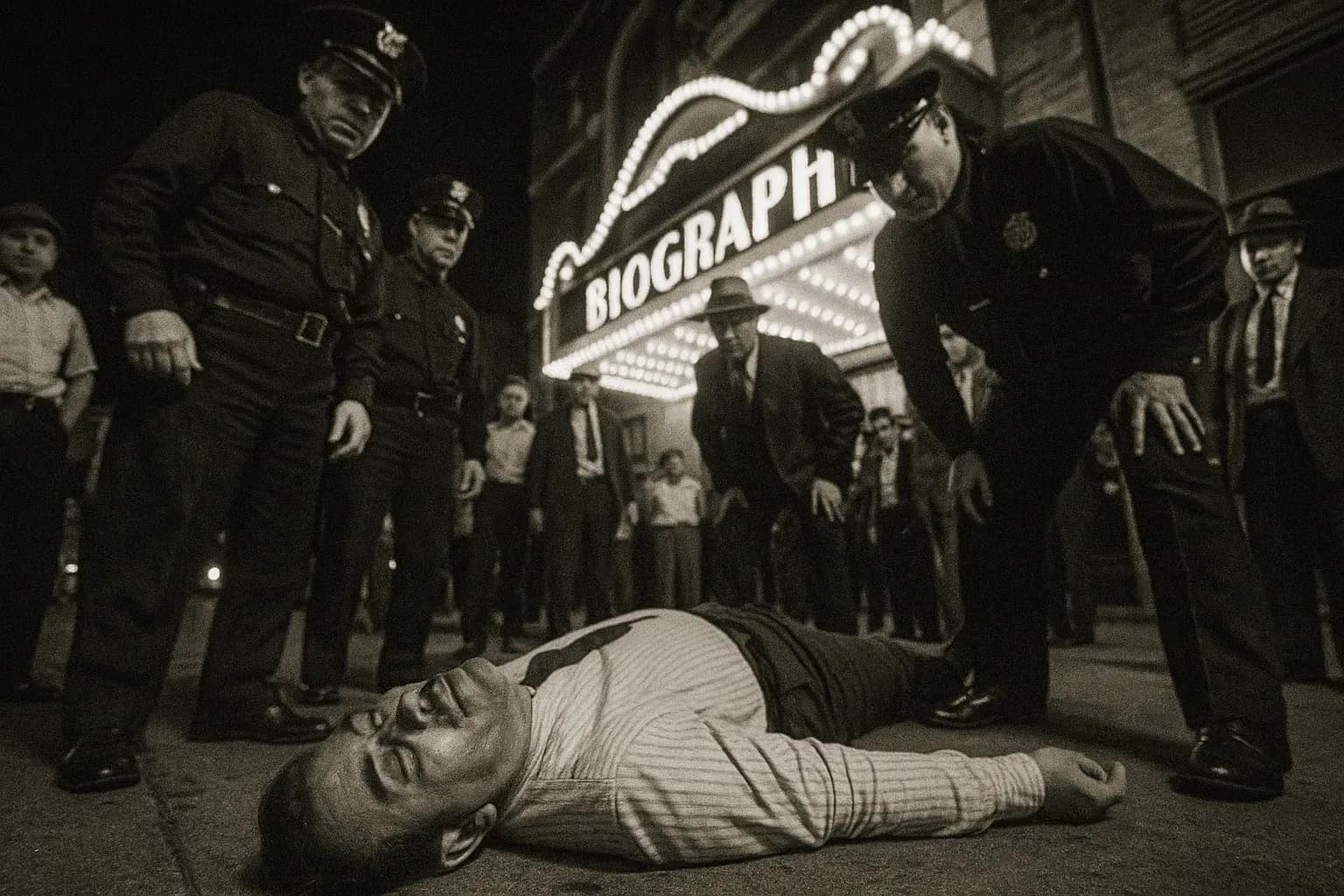
On the evening of July 22, 1934, federal agents cornered John Herbert Dillinger outside the Biograph Theater in Chicago, Illinois. The 31-year-old bank robber, who had commanded one of Depression-era America's most notorious criminal enterprises, was shot and killed during an arrest attempt at 8:30 p.m. His death ended a relentless federal manhunt and closed the chapter on one of the most wanted fugitives in American history.
Born on June 22, 1903, Dillinger had transformed from a small-time criminal into Public Enemy Number One through a calculated campaign of violence and theft. Operating as the leader of the Dillinger Gang, he orchestrated the theft from 24 banks and 4 police stations across the nation. His criminal resume also included two previous prison sentences: one for assault (ten to twenty years) and another for conspiracy to commit felony (two to fourteen years), from which he had served nine years before his eventual release.
What distinguished Dillinger from other Depression-era criminals was his ability to evade law enforcement repeatedly. Most notably, on March 3, 1934, he executed a daring escape from the Crown Point, Indiana jail using nothing more than a fake wooden gun. Carved with a razor blade and darkened with shoe polish, the crude weapon proved devastatingly effective. Dillinger forced his way past guards, stole the sheriff's car, and drove to Chicago—an action that inadvertently created a federal crime by transporting a stolen vehicle across state lines. This interstate offense became the only federal charge ever formally recorded against him, yet it sealed his designation as America's most wanted criminal.
Timeline
Federal jurisdiction gained after car theft across state line
In March 1934, Dillinger stole a car and crossed state lines, giving the FBI federal jurisdiction and formally opening the federal investigation.
Dillinger shot dead outside Biograph Theater in Chicago
On July 22, 1934, FBI agents Clarence Hurt, Charles B. Winstead, and Herman 'Ed' Hollis fired five shots. Dillinger was hit by three and declared dead at 10:50 p.m. that evening.
Two bystanders wounded during the shooting
During the shooting outside the Biograph Theater on July 22, 1934, two bystanders were hit and wounded as a result of the exchange of gunfire.
Dillinger declared dead at 10:50 p.m. at Alexian Brothers Hospital
John Herbert Dillinger was declared dead at 10:50 p.m. on July 22, 1934, at Alexian Brothers Hospital in Chicago. The case was officially closed.
The FBI's break in the case came through an unlikely source: Ana Cumpănaș, a woman later immortalized in crime lore as the "Lady in Red." On July 21, 1934—just one day before Dillinger's death—Cumpănaș approached federal agents with information about Dillinger's location and movements. In exchange for her cooperation, she negotiated protection from deportation to her native Romania, a remarkable bargaining position for someone operating outside the law.
Armed with Cumpănaș's intelligence, Division of Investigation agents (the precursor to the modern FBI) positioned themselves outside the Biograph Theater, where Dillinger was known to spend his evenings. When the fugitive exited the theater into the Chicago night, federal agents made their move. The confrontation ended in gunfire, and Dillinger fell mortally wounded. The operation represented a significant victory for federal law enforcement at a time when the public desperately wanted relief from the violent crime wave sweeping the nation.
Dillinger's reign as Public Enemy Number One lasted less than a year at the top of the FBI's most-wanted list, but his legend endured far longer. The combination of his audacity, his ability to escape seemingly inescapable situations, and the dramatic circumstances of his death cemented his place in American criminal folklore.
It should be noted that some researchers have disputed whether Dillinger was actually killed at the Biograph Theater, suggesting alternative theories about his fate. However, the official account remains that he died there on July 22, 1934, bringing an end to one of the most intense manhunts in the nation's history.
Sources:
https://kids.britannica.com/students/article/John-Dillinger/274007
https://reason.com/2014/07/22/eighty-years-ago-today-john-dillinger-he/
https://en.wikipedia.org/wiki/John_Dillinger
https://www.ebsco.com/research-starters/history/john-dillinger
Ask about this case
Answers from KrimiNyt's coverage onlyFollow this case
Get an email when a new documentary, podcast or book about Public Enemy Number One: The FBI's Hunt for John Dillinger appears, or when a verdict is reached.